A complete guide to every accommodation option — from pilgrim hostels to centuries-old Paradores — with honest pros, cons and insider advice.
All accommodation types at a glance
Before diving in, here is an honest overview of everything you will find on the Camino — with real price ranges and who each option genuinely suits.
Type | Price/night | Room | Best for | Tier |
|---|---|---|---|---|
Municipal albergue | €5–10 | Shared dorm | Budget pilgrims, social experience | Budget |
Parochial albergue | Donation–€10 | Shared dorm | Spiritual pilgrims | Budget |
Private albergue | €12–20 | Small dorm | Social but comfort-conscious | Budget |
Pension | €40–70 | Private room | Couples, privacy seekers | Mid-range |
Casa Rural / Pazo | €50–110 | Private room | Authentic rural character | Mid-range |
Hotel / guesthouse | €70–130 | Private en-suite | Comfort-focused pilgrims | Mid-range |
Monastery / convent | €15–40 | Private or shared | Spiritual immersion | Mid-range |
Parador | €150+ | Private en-suite | Special occasions, history lovers | Premium |
Albergues — the classic pilgrim hostel
If you ask a hundred people who have walked the Camino what they remember most vividly, a disproportionate number will describe a scene from an albergue. Not the scenery, not the cathedral — an albergue. The person who lent them a bandage in Pamplona. The long dinner table in O Cebreiro where a retired doctor, a young Japanese student and a grandmother from Buenos Aires shared a bottle of wine and talked for three hours. The sound of thirty people breathing in the dark, everyone exhausted, everyone pointed in the same direction.
Albergues are pilgrim hostels designed specifically for people walking the Camino. They come in three distinct flavours, each with its own character.
Municipal albergues
Managed by local town or regional councils, municipal albergues are the cheapest option on the Camino at €5–10 a night. Large shared dormitories, communal bathrooms, no frills. They operate on a strict first-come, first-served basis — no reservations, ever — which adds a genuine element of daily uncertainty to your walk. During peak summer months on the Camino Francés, beds in popular stages are gone by early afternoon. That knowledge becomes part of your rhythm.
None of that is a complaint. The constraints are part of what makes municipal albergues feel like the purest Camino experience. Everyone is in the same boat. That shared vulnerability tends to produce conversations that would never happen in a hotel lobby.
Private albergues
Independently owned, these hostels cost a little more — typically €12–20 a night — and the difference usually shows. Smaller dormitories (often 8–16 beds rather than 40+), better bathrooms, sometimes a kitchen or a bar. Many private albergues have become beloved institutions, run by former pilgrims who brought their own experience of the Camino to the way they look after guests.
The important practical difference: private albergues usually accept reservations, which matters enormously on the Sarria-to-Santiago stretch in July and August.
Parochial and confraternity albergues
Run by parishes, religious brotherhoods, or Camino confraternities, these albergues often ask only for a donation. In exchange, they offer something other hostels cannot: a genuine contemplative atmosphere, evening pilgrim blessings, communal dinners, and sometimes early morning mass. They tend to have firm rules — curfews, lights out by ten — and the atmosphere is quieter and more intentional than a standard dorm.
For pilgrims who are walking for reasons that go beyond fitness, these places often become the most significant stops of the whole journey.
You’ll need a pilgrim passport: All albergues — municipal, private and parochial — require a credencial del peregrino (pilgrim passport) to check in. You collect stamps at accommodation, churches and cafes along the way. You can get yours from Camino confraternities in your home country, at churches at the start of most routes, or through a tour operator before you leave.


Pensions
A pension is a small, usually family-run guesthouse offering private rooms at moderate prices — typically €40–70 a night, often with breakfast included. They sit between the albergue and the hotel in terms of both cost and character.
What pensions offer that larger hotels often cannot is the sense of being genuinely looked after by someone who knows the local area intimately and takes some personal interest in your walk. A pension owner who has been welcoming pilgrims for twenty years knows which bar opens earliest, which section of the next stage has the most exposed ridge in bad weather, and which albergue in the next town is worth avoiding. That information is freely shared over a café con leche at seven in the morning, and it is worth more than the room rate.

Hotels and guesthouses
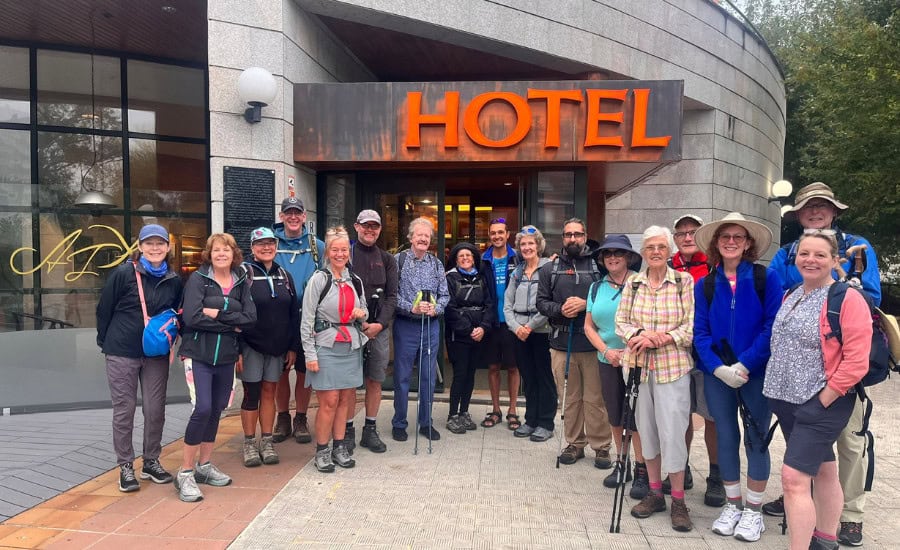
There is a persistent myth that sleeping in hotels makes a Camino somehow less authentic. It is worth naming and dismissing. The pilgrimage is in the walking. Where you sleep has never been part of the contract.
Staying in hotels and guesthouses along the Camino means a private room, a private bathroom, and the kind of sleep that actually repairs a body that has walked 700 kilometres. For solo walkers over a certain age, for people with specific physical conditions, for couples who want the evenings to themselves, for anyone who knows that their ability to keep walking depends on genuine recovery — this is not a luxury, it is a practical necessity.
Hotels along the Camino routes range from small family-run three-stars in modest market towns to beautifully converted stone manor houses with gardens and restaurant kitchens that take local cuisine seriously. The quality of what you find at €80–100 a night in rural Galicia or Navarra would surprise most people accustomed to city hotel prices.
About off-route transfers: Some of the most characterful hotels along the Camino sit a kilometre or two off the path. Many offer complimentary transfers to and from the nearest point on the route — meaning you don’t sacrifice a single step of the walk. Always confirm this service when booking or through your tour operator.


Casas Rurales and Pazos
The Casa Rural — rural house — is one of Spain’s most appealing accommodation traditions. Family-run, set in traditional stone farmhouses or country properties, they blend authentic regional architecture with proper modern amenities. On the Galician routes especially, the equivalent is the Pazo: a historic manor house, often of some architectural significance, converted into a guesthouse with the kind of thick-walled, high-ceilinged dignity that no new-build can replicate.
Both types of property tend to be set slightly apart from the centre of towns — in orchards, near rivers, on hillsides — which means the evenings feel very different from those spent in albergues or roadside hotels. The surroundings are quiet. Breakfast tends to involve things grown on the property or bought locally that morning. The owners, in most cases, actually want to talk to you.
These properties are best booked well in advance, especially from May onwards, as they tend to be small — sometimes only six or eight rooms — and fill quickly on popular routes.

Paradores
Spain’s network of Paradores Nacionales is one of the great hidden pleasures of European travel: former royal palaces, medieval castles, 16th-century pilgrim hospitals, and ancient convents converted by the Spanish state into four- and five-star hotels that have preserved their historic bones entirely.
Several of the finest Paradores in Spain sit directly on Camino routes. Walking into the Parador de Pontevedra — a 16th-century Renaissance palace — after a long day on the Portuguese Way, or arriving at the Parador de Baiona in a converted medieval fortress overlooking the Galician coast, is the kind of experience that stays with a person.
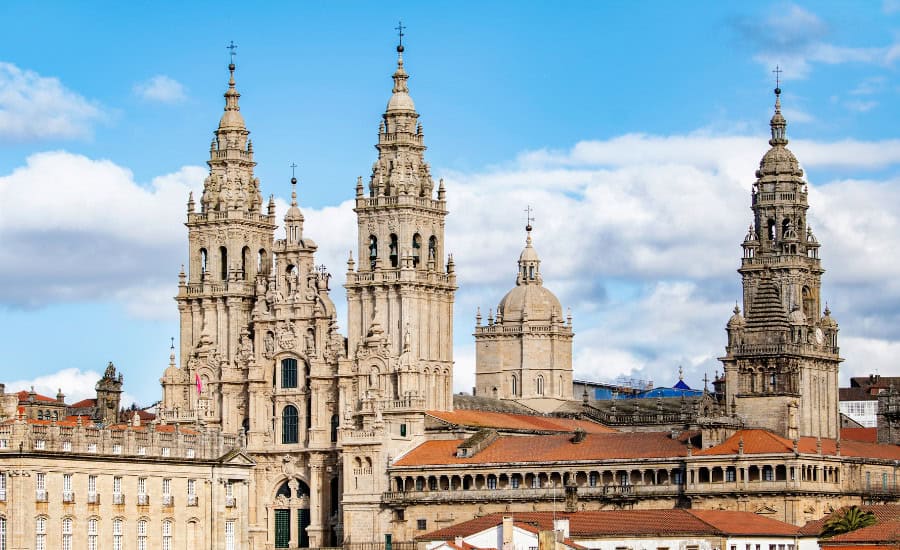
The most famous is the Parador de Santiago de Compostela — Reyes Católicos, which sits directly on the Plaza del Obradoiro, the arrival square for most Camino routes. Built in 1501 as a royal hospital to care for pilgrims completing the journey, it is widely cited as one of the oldest hotels in the world. Finishing 800 kilometres of walking and stepping through those doors carries a weight that is difficult to describe to someone who hasn’t felt it.
Booking tip: The Parador de Santiago books out months in advance for summer dates and the Feast of St. James (25 July). If it’s on your list, plan for it early — three to four months ahead at minimum. Some pilgrims book their final night as a Parador arrival and walk in from standard accommodation the rest of the route. That combination works very well.


Camping
Most Camino pilgrims sleep under a roof. A small number don’t, by choice, and their experience of the route is genuinely different — more exposed, more physical, more directly connected to the land underfoot.
Camping is legal on the Camino in officially designated areas. Wild camping outside those areas is prohibited under Spanish law and should be respected, both for legal reasons and out of care for the landscape that the route depends on. The Galician sections of the Camino Francés and Camino Portugués receive substantial rainfall year-round; you need a tent rated for genuine wet conditions, not a festival pop-up.
The weight trade-off is real. A proper one-person tent, sleeping mat, and sleep system add meaningful kilograms to a pack that you will carry for weeks. Most experienced Camino walkers, asked honestly, will tell you the weight isn’t worth it given the density of affordable accommodation along every major route. But for those who find the tent itself part of the point, the Camino rewards the commitment.

What Follow The Camino includes in its packages
We are often asked exactly what kind of accommodation we use for our pilgrims.
Follow The Camino offers four accommodation categories to suit different budgets and travel styles. Every bed, at every level, is pre-booked before you leave home — so you never arrive at the end of a long day’s walk to find the town is full.
Comfort
Our most-booked category. A carefully selected mix of quality hotels, charming guesthouses and characterful Pazos — chosen for character and location at every stop along your route.

Budget
Simple, well-located guesthouses and pensions with private rooms. All pre-booked, all vetted by our team. The walking is identical — only the overnight comfort level changes.

Deluxe
The finest properties on each route — boutique hotels, historic manor houses and Paradores throughout. For pilgrims who want exceptional accommodation to match an exceptional journey.

Hostel
Shared rooms in quality hostels along the route. The most affordable Follow The Camino option — with all the support and planning of a full package, none of the daily scramble for a bed.

You can mix categories — and many pilgrims do:
Travelling on a budget but want to arrive in Santiago and spend your final night in the Parador de los Reyes Católicos — right on the cathedral square, one of the oldest hotels in the world? That is completely possible. We build bespoke itineraries that combine categories night by night, so you can save where it makes sense and invest where it genuinely matters to you. Just tell us what you have in mind.