
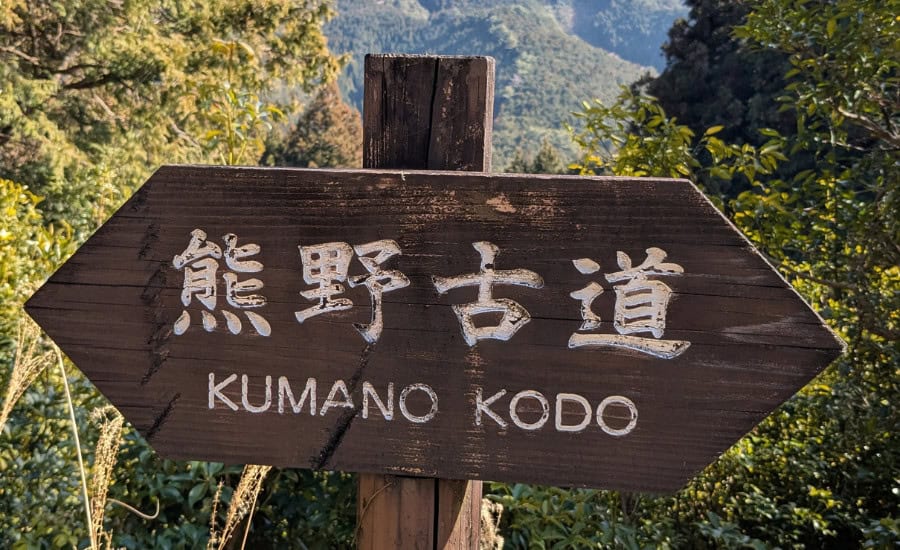
When we talk about pilgrimage at Follow the Camino, we usually talk about following someone. On the Camino de Santiago, pilgrims walk towards the tomb of St James. On the Via Francigena, they head for Rome and the tomb of St Peter. On the St Francis Way, they follow the life of Francis of Assisi. In each case, a single figure has drawn walkers along the same road for centuries.
The Kumano Kodo works differently. It is a network of ancient trails in the mountains of the Kii Peninsula, south of Osaka, and it does not lead to a person. It leads to a place, or rather to three: the Grand Shrines of Kumano, known together as the Kumano Sanzan.
- Kumano Hongu Taisha, in the heart of the mountains
- Kumano Hayatama Taisha, near the mouth of the Kumano River in Shingu
- Kumano Nachi Taisha, beside the Nachi waterfall
For more than a thousand years, people have walked through these forests looking for healing, renewal and a sense of the sacred. This is the story of who they were, and why the path still matters today.

A sacred landscape: Shinto, Buddhism and the mountains of Kumano
To understand the Kumano Kodo, you have to start with the land itself. Leave Japan’s cities behind and the country turns green very quickly: mountains, cedar forests, rivers, waterfalls and hot springs. On the Kii Peninsula all of this comes together, and the early Japanese saw it as more than scenery. In Shinto belief, kami (deities and spirits) live in nature. A rock, a giant tree or a waterfall could be a place of worship in its own right.
Kumano appears very early in Japanese writing. The Nihon Shoki, a chronicle completed in 720, links the area to the burial place of Izanami, the mother goddess of Japanese mythology. From the start, Kumano was seen as a land at the edge of the everyday world, close to the gods and to the dead.
Buddhism reached Japan in the mid-sixth century, arriving through the Korean kingdom of Baekje with images of the Buddha, scriptures and ritual objects. It did not take hold overnight. It spread slowly through the imperial court, powerful families, temples and trade with the continent.
In Kumano, the two traditions did not compete. They blended. The kami of the three shrines came to be understood as local forms of Buddhist deities, and mountain ascetics known as Shugendo practitioners trained on these same slopes. So the mountains and forests were not a backdrop to religion. They were part of the spiritual world. That is why walking through the landscape, rather than simply arriving, has always been at the centre of the Kumano pilgrimage.

The imperial pilgrimages to Kumano
In 794 the capital moved to Heian-kyo, today’s Kyoto, and the court began to look south towards Kumano. Retired Emperor Uda made the journey in the early tenth century. But the real turning point came in 1090, when retired Emperor Shirakawa made his first pilgrimage.
What followed is remarkable. Between 1090 and the early 1220s, four retired emperors made close to one hundred pilgrimages to the Kumano shrines. Go-Shirakawa alone is said to have gone 34 times, and Go-Toba made the trip more than 25 times. Each journey from Kyoto took weeks, on foot and by boat, through steep and difficult terrain.
Why go so often? For these rulers, Kumano offered purification, healing and divine protection. Many had stepped down from the throne but still held real power, and the pilgrimage was both a spiritual practice and a public act of devotion.
These processions shaped the route we walk today. Along the way, small subsidiary shrines called oji were set up for rest and prayer, and some of them still mark the trail. The poet Fujiwara no Teika travelled with Go-Toba in 1201 and kept a diary of the journey, one of the oldest written accounts of the Kumano pilgrimage.

The “pilgrimage of ants”: when everyone walked to Kumano
At first, the Kumano pilgrimage belonged to the court and the aristocracy, the only people with the time and resources to make it. Over the following centuries that changed. After the early thirteenth century, local samurai began to walk the trails, and by the Muromachi period (1333 to 1573) monks, merchants, farmers and ordinary families were on the road too.
Kumano faith helped. It was known for welcoming everyone, regardless of social rank, gender or even belief. Travelling preachers, including women known as Kumano bikuni, carried painted mandalas from village to village and told the stories of Kumano, inviting people to make the journey.
The crowds grew so large that people began to describe them as ari no Kumano mode, the “pilgrimage of ants”: long, steady lines of walkers moving through the mountains one behind the other. As more people came, paths were improved, shrines multiplied and simple lodgings opened along the routes. In the Edo period (1603 to 1867), Kumano became, along with Ise, one of the great pilgrimages of ordinary Japanese life.
The tradition faded in the modern era, as Japan changed rapidly and the government reorganised religious life. For much of the twentieth century, many of these paths were quiet. Their revival is a recent story.

Walking the Kumano Kodo today: an ancient path, a gentle way into Japan
The Kumano Kodo is made up of several routes, including the Nakahechi, Kohechi, Ohechi and Iseji. The Nakahechi route is the one the Heian emperors used, and it is still the classic choice. It runs from Takijiri-oji through the mountains to Kumano Hongu Taisha and on to Kumano Nachi Taisha.
Modern walkers still cross stone-paved paths laid centuries ago, pass beneath cedars and camphor trees, stop at small oji shrines and arrive at sacred sites that have welcomed pilgrims for a thousand years. Walkers today carry lighter packs and use maps on their phones, but the heart of the experience has not changed: walking slowly, feeling the effort in your legs, and watching the landscape shift around you.
What surprises many first-time walkers is how accessible it feels. The trail is deeply natural and often quiet, yet it is supported by good transport, clear signage and traditional Japanese guesthouses. Many evenings end with a soak in a hot spring and authentic local food. You get the forest pilgrimage without having to manage a wilderness trek.
Our Kumano Kodo tour from Takahara to Kumano Nachi Taisha covers the classic Nakahechi route over six days, with about 72 km of walking. We arrange your hand-picked accommodation, your pilgrim pack and a virtual pre-departure briefing, and we are on call 24/7 while you walk. On longer days, bus options let you shorten the stage, so you can walk at a pace that feels right for you.

An ancient path with room for everyone
What began as a journey for emperors and aristocrats became, over the centuries, a road for samurai, monks, villagers and travellers from all over the world. Its meaning has widened too. For some, the Kumano Kodo is still a religious pilgrimage. For others, it is a cultural journey, a personal reset or a physical challenge.
The essence has not changed. You enter a sacred landscape, you walk with intention, and you let the path shift your perspective a little, one forest step at a time. That is why, more than a thousand years on, the Kumano Kodo still has a place for everyone.
Ready to walk in the footsteps of emperors? We take care of the logistics so you can focus on the journey. Plan your Kumano Kodo pilgrimage with us, or talk to one of our Camino advisors about combining it with the Camino de Santiago to become a Dual Pilgrim.