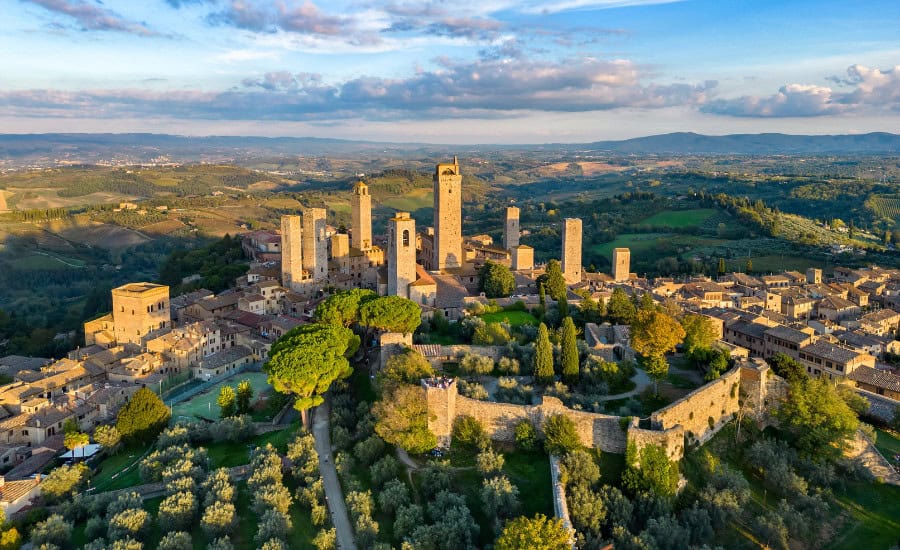
Fourteen towers, a UNESCO skyline unchanged in 700 years, and the world’s most-awarded artisan gelato. Here’s everything you need to know before you arrive.
San Gimignano is one of the best-preserved medieval towns in Europe. Small enough to walk end-to-end in 20 minutes, rich enough to keep you busy for two days. The kind of place that stays with you long after you’ve left — which is, you suspect, exactly the effect it had on the pilgrims who passed through here 800 years ago.
We’ve been sending travellers and pilgrims through San Gimignano for years as part of our Via Francigena tours through Tuscany. In that time we’ve collected the questions people ask, the mistakes they make, and the things they’re most glad they did. This guide is that knowledge, organised.

The Story: Why did they build so many towers?
The towers of San Gimignano were not defensive structures. They weren’t watchtowers or military fortifications. They were, in the most human possible sense, a flex.
San Gimignano sat at a key junction on the Via Francigena — the main pilgrimage road connecting northern Europe to Rome. From the 10th to 13th centuries the town grew wealthy on two commodities: saffron (still grown here today, still DOP-protected) and copper. That wealth pooled in the hands of rival noble families — the Ardinghelli and the Salvucci most prominently — and they did what wealthy rivals have always done: competed to outdo each other.
The towers were their scoreboard. At the peak of this medieval arms race, 72 towers rose above the town walls. Building regulations eventually capped new towers at the height of the tallest existing one (the Palazzo Comunale’s Torre Grossa, still standing at 54 metres) — which only intensified the competition to build faster before the rules changed.
San Gimignano is sometimes called the “Manhattan of the Middle Ages” — not because of skyscrapers, but because of something far older than Manhattan: the human need to build taller than your neighbour to prove a point.
In 1348, the Black Death halved the population. The town’s economic power collapsed, and San Gimignano surrendered its independence to Florence in 1353. Ironically, this political defeat may have saved it: Florence had no reason to develop or modernise the place, so it stayed exactly as it was. A medieval town that simply never had to grow up. When the Grand Tour travellers arrived in the 18th and 19th centuries, they found it essentially intact — and were astonished. We still are.
What to See: The sights that are worth your time (and the ones that aren’t)
San Gimignano is small enough that you could technically see the main sights in four hours. Don’t. Rushing through it is one of the most common mistakes visitors make — and it usually means spending those four hours fighting crowds rather than experiencing the place.
Here’s what actually deserves your attention:

Torre Grossa
The tallest of the 14 surviving towers at 54 metres. You climb a series of increasingly steep internal staircases, emerging onto a terrace with a 360° view of the Tuscan countryside. Worth every step. Arrive when it opens to avoid queues that can reach 45 minutes by midday.

Collegiata di Santa Maria Assunta
Looks modest from outside. Inside is one of the most complete cycles of medieval frescoes in Italy — Old Testament scenes, a New Testament cycle, and Ghirlandaio’s extraordinary Santa Fina Chapel. Allow 60–90 minutes. Closed lunchtimes and Sunday mornings.

Museo Civico
Located in the Palazzo Comunale, this compact museum holds important works by Pinturicchio and Filippino Lippi, and a medieval council room with a fresco portrait of Dante — who visited San Gimignano as a Florentine ambassador in 1300. Fascinating for anyone who’s read the Commedia.
Vernaccia Wine Tasting
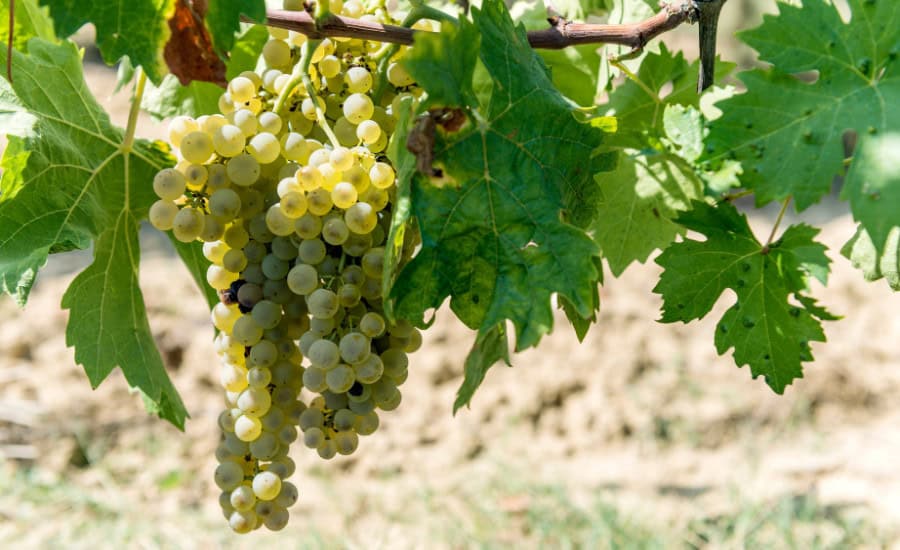
Vernaccia di San Gimignano was the first Italian wine to receive DOC status, in 1966 — though it was already being shipped to the papal court in the 13th century. Crisp, mineral, slightly bitter finish. Multiple enotecas around Piazza della Cisterna offer tastings. Non-negotiable.

The Town Walls
Partially accessible on foot. The section near Porta San Jacopo offers views inward over terracotta rooftops and outward over vineyards. The approach to the walls from Piazza delle Erbe in the evening, when the light goes golden, is one of the quietest and most beautiful spots in the whole town.

Just Walking
The most underrated thing to do. San Gimignano’s side streets — Via del Castello, the lanes around Piazza delle Erbe, the steep path down to Sant’Agostino church — are where the town really reveals itself. No ticket required. Go without a plan and see what you find.
Timing tips that will actually change your experience
- The tour group window is roughly 10am–4pm. Arrive before 9am or after 4:30pm and it’s a different town
- Torre Grossa ticket queues peak between 11am–2pm — climb first thing or late afternoon
- The Collegiata closes for lunch (approx. 12:30–3pm) and charges admission — plan around this
- Thursday mornings: a small market in Piazza del Duomo sells local saffron, cheese and cured meats worth buying
- Via Francigena pilgrims enter from the north through Porta San Matteo — quieter than the tourist entrance at Porta San Giovanni
The Food Question: The gelato, the wine, and what else to eat
Let’s get the gelato question out of the way: yes, it really is that good, and yes, the queue is usually worth it.
Gelateria di Piazza (also known as Gelateria Dondoli, after founder Sergio Dondoli) has won the World Gelato Championship multiple times. The signature flavour — Crema di Santa Fina, made with local saffron and pine nuts — has never been adequately replicated anywhere else. Order this. Then, if you have room, order the champagne sorbet.
The queue tends to be longest between noon and 3pm. Visit in the early evening when day-trippers have left and the light on the piazza has turned the colour of, well, saffron. The wait is shorter and the experience is better.
Beyond gelato, the local cooking is shaped by what grows in the surrounding hills:
- Saffron (Zafferano DOP): The local saffron has DOP protected status. It colours pasta, risotto, desserts, and yes, the gelato. Buy some strands to take home — the quality is noticeably higher than what you’ll find in a supermarket.
- Vernaccia di San Gimignano: A crisp white wine, first documented in 1276, with a mineral quality and a slightly bitter almond finish. Michelangelo reportedly loved it. Pair with local pecorino or anything fried. Don’t skip it.
- Wild Boar (Cinghiale): Slow-cooked wild boar ragu on pappardelle is the Tuscan hill town dish. Deeply savoury, rich, and almost certainly going to make you order a second glass of wine. Every trattoria in town makes a version.
- Ribollita: A twice-cooked bread and vegetable soup that’s been feeding Tuscan farmers through cold winters for centuries. Hearty, cheap, genuinely good. Perfect fuel for the next day’s stage on the Francigena.

San Gimignano on the Via Francigena
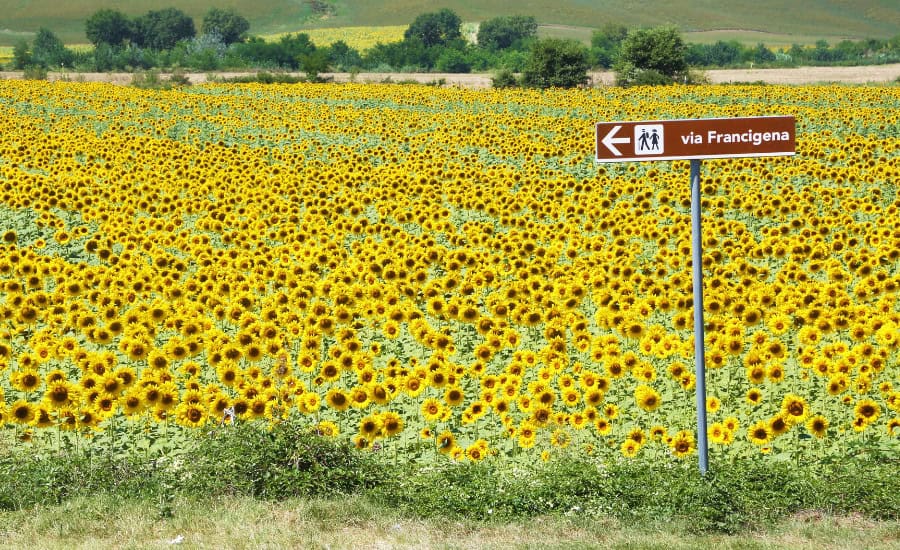
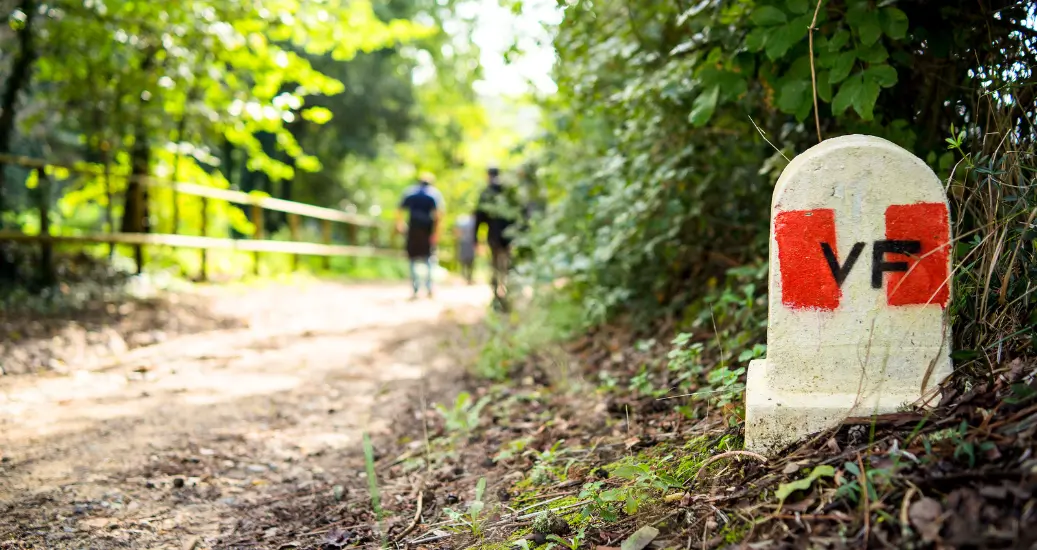
If you’re walking the Via Francigena, San Gimignano will almost certainly be one of the emotional highlights of the Italian leg. There’s something that happens when you arrive here on foot after days of walking — when you push through Porta San Matteo and see those towers rising above you. You’re seeing exactly what medieval pilgrims saw. The skyline hasn’t changed.
The town has long understood pilgrims. There’s a dedicated ostello del pellegrino, restaurants familiar with the credenziale, and a general warmth toward walkers that you notice immediately. People can tell you’ve been walking for days, and they tend to treat that with a certain respect.
Practical tips for Via Francigena pilgrims specifically
- Get your credenziale stamped at the Comune (Town Hall), Piazza del Duomo — it’s an official Francigena stamp and worth having
- Take a rest day here if your schedule allows: the stage south toward Monteriggioni is demanding and rewards fresh legs
- The Sant’Agostino church (north of centre, less crowded) has a beautiful Gozzoli fresco cycle and is often overlooked by non-pilgrim visitors
- Stock up on provisions: local saffron, Vernaccia (pack carefully), dried porcini and pecorino all travel well
- Follow the Camino can arrange luggage transfer between stages so you explore the town without your pack
How to spend one day in San Gimignano
If you only have a day, this is how we’d spend it. The logic is simple: do the things that require tickets early (before crowds), use the midday lull for eating, and save the wandering and wine for the afternoon when the light is best and the tour groups are leaving.
| Time | What to do | Why this order |
|---|---|---|
| 8:00–9:00 | Early walk + climb Torre Grossa | Virtually no queue. The morning haze over the hills burns off by 9am — crisp views and golden light. |
| 9:00–10:30 | Collegiata frescoes | Opens at 10am (check seasonal hours). Get in early — the nave fills up by mid-morning. Allow 60–90 minutes minimum. |
| 10:30–12:00 | Side streets and Museo Civico | Wander Via del Castello and the lanes around Piazza delle Erbe. Visit the Museo Civico for the Dante room. |
| 12:00–13:30 | Lunch | La Mangiatoia for ribollita and wild boar. Or a quick panino from a deli on Via San Matteo if you’d rather keep moving. |
| 13:30–15:30 | Vernaccia tasting + rest | Visit an enoteca near Piazza della Cisterna. Then: sit somewhere, order something cold, do nothing. You’ve earned it. |
| 15:30–18:00 | Walk the walls + photography | The afternoon light on the towers is extraordinary. Position yourself outside the walls to the south for the classic panoramic shot. |
| 18:00+ | Gelato at Dondoli’s, then dinner | Queue is shorter now. Dinner anywhere — the whole town cooks well. Order the truffle pasta if it’s on the menu. |

San Gimignano is waiting.
So is the road to Rome.
From the towers of San Gimignano to the dome of St. Peter’s — the Via Francigena is one of the world’s great walks. Let us help you walk it your way.