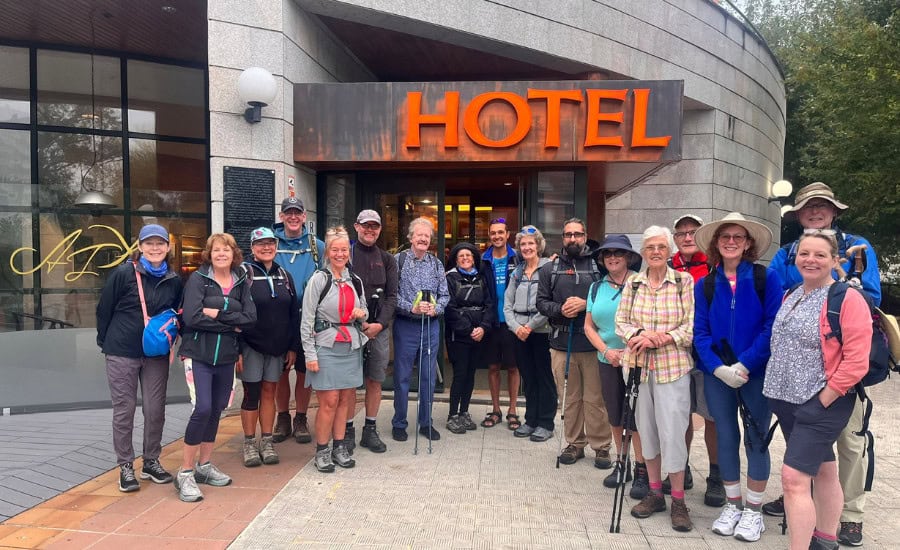
Every year we get the same message, in one form or another: “I’ve never done anything like this. Am I fit enough?” If that’s the question that brought you here, take a breath. You are exactly the person this guide is for.
The truth is, the Camino de Santiago doesn’t ask for athletic ability. It asks for consistency. Most of the pilgrims we walk with are not runners, not gym regulars, not “outdoorsy” in the way Instagram makes it look. They’re teachers, nurses, retired engineers, grandmothers walking for the second time. What they have in common isn’t fitness, it’s that they trained a little, regularly, in the months before they left.
This is the training plan we wish someone had handed us before our first Camino. No jargon, no unrealistic mileage, just what actually gets your legs, your feet and your head ready for the trail.
How Fit Do You Actually Need to Be for the Camino?
Here’s the honest answer: less fit than you think, but more prepared than you’d like to believe.
Most guided Camino itineraries average 15 to 22 km a day, on mixed terrain, mostly flat with rolling sections. That’s very walkable for almost anyone in reasonably good health, as long as your body has practiced carrying a daypack and being on its feet for four to six hours, several days in a row. That “several days in a row” part is the piece people usually skip in training, and it’s the piece that actually matters.
You don’t need to be able to run 10k. You need to be able to walk, tired, on day four, and still enjoy yourself. That’s a different kind of fitness, and it’s one you can absolutely build.
The 12-Week Camino Training Plan
We’ve broken this into four stages. If you have less time than 12 weeks, compress it, don’t skip it, especially the last four weeks with the loaded pack.
Weeks 1–3: Build the habit
- Walk 3 to 4 times a week, 30 to 45 minutes, at a comfortable pace.
- No pack yet. This stage is about getting your body used to moving regularly, not about intensity.
- Start breaking in the shoes or boots you plan to walk in. Wear them around the house and on short walks, never for the first time on the Camino.
Weeks 4–6: Add distance
- Increase your longer walk of the week to 8 to 10 km.
- Start carrying a light daypack (water, phone, a jacket) on at least one walk per week.
- Pay attention to your feet. Any hot spots or rubbing at this stage is useful information, not a problem.
Weeks 7–9: Add consecutive days
- Try to walk on two consecutive days at least once during this stage, even if the distances are modest. This is what teaches your legs to recover overnight and go again, which is exactly what the Camino asks of you.
- Increase your longest walk to 12 to 15 km.
- Practice with the daypack loaded closer to what you’ll actually carry.
Weeks 10–12: Simulate the real thing
- Aim for one or two walks in the 15 to 18 km range, ideally on varied terrain, not just flat pavement.
- If you can manage a weekend of two back-to-back longer walks, do it. It’s the single best predictor of how your body will feel on the Camino.
- Taper the final week. Light movement only, let your legs arrive fresh, not tired.


What to Actually Practice (Not Just How Far)
Distance gets all the attention, but three other things determine how your Camino feels:
Your footwear, broken in properly. New boots on day one of the Camino is one of the most common (and avoidable) causes of blisters we see. Whatever you plan to walk in, wear it on at least half of your training walks.
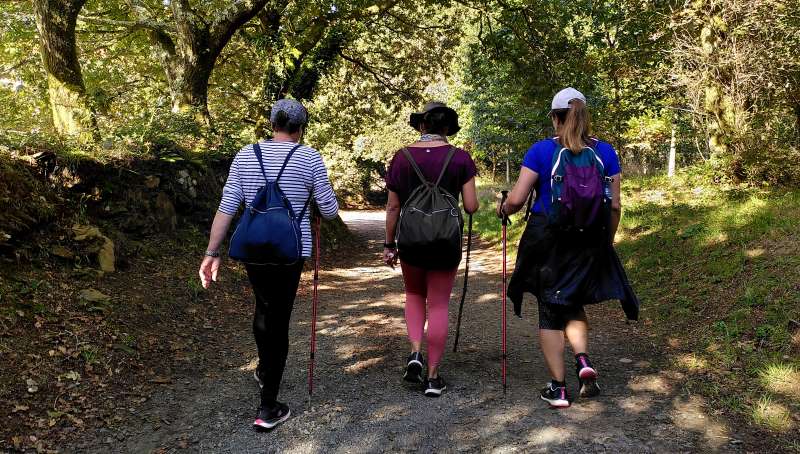
Walking with a loaded daypack. Even with luggage transfer included, as it is on our guided and self-guided trips, you’ll still carry a daypack with water, a layer, sunscreen and snacks. Training with that same weight matters more than training with none at all.
Walking poles, if you plan to use them. They take real pressure off your knees on descents, but only if your body has learned the rhythm before you’re on the trail. Practice with them, don’t improvise on day one.
If any of this feels like a lot to figure out on your own, that’s exactly why we put together a free, step-by-step training ebook with weekly checklists, stretching guidance and a packing list built specifically for the Camino. You don’t have to plan this from scratch.
The Week Before You Fly
- Stop increasing distance. Your training is done, this week is about arriving rested, not fitter.
- Walk your shoes one more time to double-check nothing has shifted (new insoles, new socks).
- Pack your daypack exactly as you’ll carry it and do one short, easy walk with it, just to feel settled.
- Check your documents.
You Won’t Be Doing This Alone
This is worth saying plainly: preparing physically is only part of feeling ready. A lot of the nervousness pilgrims describe to us isn’t really about kilometers, it’s about the unknown, walking somewhere new, not knowing what a day will actually look like.
That’s the piece we take off your plate. On a Follow the Camino guided or self-guided trip, your route is planned, your bags move ahead of you, your accommodation is booked, and there’s always someone on call if you need us. You bring the training. We take care of the rest.