Short Break Camino Portugues: Caldas de Reis to Santiago de Compostela

Camino Portugues Short Break: Caldas de Reis to Santiago de Compostela

Camino Portugues Short Break: Caldas de Reis to Santiago de Compostela

Starting from

401

Some journeys don’t need to be long to be unforgettable. With just two days of walking, you can experience one of the world’s great pilgrimage routes — arriving in Santiago de Compostela exactly as pilgrims have for centuries: on foot, with tired legs and a full heart.

This short break follows the final stretch of the Camino Portugués, the Portuguese Way, tracing ancient paths north from the elegant spa town of Caldas de Reis through the green heart of Galicia. This historic route was walked by royalty and pilgrims alike, and its final kilometres weave through woodland, farmland and quiet Galician villages before delivering you to one of Europe’s most magnificent squares.

Set off on Saturday morning, walk at your own pace through landscapes that have barely changed in centuries, and by Sunday afternoon you’ll be standing in the Praza do Obradoiro. Stay an extra night to explore Santiago’s cobbled streets, incredible food scene, and timeless atmosphere before heading home.

The Camino asks only that you show up. Everything else takes care of itself.

Some journeys don’t need to be long to be unforgettable. With just two days of walking, you can experience one of the world’s great pilgrimage routes — arriving in Santiago de Compostela exactly as pilgrims have for centuries: on foot, with tired legs and a full heart.

This short break follows the final stretch of the Camino Portugués, the Portuguese Way, tracing ancient paths north from the elegant spa town of Caldas de Reis through the green heart of Galicia. This historic route was walked by royalty and pilgrims alike, and its final kilometres weave through woodland, farmland and quiet Galician villages before delivering you to one of Europe’s most magnificent squares.

Set off on Saturday morning, walk at your own pace through landscapes that have barely changed in centuries, and by Sunday afternoon you’ll be standing in the Praza do Obradoiro. Stay an extra night to explore Santiago’s cobbled streets, incredible food scene, and timeless atmosphere before heading home.

The Camino asks only that you show up. Everything else takes care of itself.

Stage 5 of 5

43.3km

4 days

Comfort

Popular time

september

Starting from

401

Starting from

401

Route Summary

Stage 5 of 5

43.3km

4 days

Comfort

Popular time

september

Best time to go:

Jan
Feb
Mar
Apr
May
Jun
Jul
Aug
Sep
Oct
Nov
Dec
Popular Time
Good Time
Off/Low Season
Not Possible

Overall

Distance:

18.7 min | 21.7km average | 24.7 max

Ascent:

315.6 min | 421m average | 526.3 max

Cardio:

3   3.5   4

Follow the Camino Preview Map Trip 1348
Services Availability Advice advice
Food Food
Water Water
Toilet Toilets
Plentiful Plentiful

Facilities are abundantly available along the route.

Minimal recommended carry per person (keep well hydrated and energy coming in between services places):

  • 0.5 L water
  • One small snack (fruit, bar, nuts)
Marking Marking
Plentiful Plentiful

Clear and frequent signage

Follow the signs and enjoy the walk

View the popular times to visit this route

Jan
Feb
Mar
Apr
May
Jun
Jul
Aug
Sep
Oct
Nov
Dec
Popular Time
Good Time
Off/Low Season
Not Possible

Overall

Distance:

18.7 min | 21.7km average | 24.7 max

Ascent:

315.6 min | 421m average | 526.3 max

Cardio:

3   3.5   4

Follow the Camino Preview Map Trip 1348
Services Availability Advice advice
Food Food
Water Water
Toilet Toilets
Plentiful Plentiful

Facilities are abundantly available along the route.

Minimal recommended carry per person (keep well hydrated and energy coming in between services places):

  • 0.5 L water
  • One small snack (fruit, bar, nuts)
Marking Marking
Plentiful Plentiful

Clear and frequent signage

Follow the signs and enjoy the walk

Highlights

Church in Padron

Padron

The last main town before reaching Santiago de Compostela on the Camino Portuguese is Padron and this is also the town where St James’ body was returned to the Iberian Peninsula from Jerusalem. A must-see in town is the Church of Santiago. There, below the altar, is the original stone O Pedrón, which is said to be the mooring post that the boat carrying St James was tied up to. Another wonderful place to visit is Monte Santiaguino – it is here that St James is said to have first preached in Spain. A short but steep walk up to Monte Santiaguino is well worth it for the tranquillity and views back over Padron.

Albarino Wine making grape picker

Albarino Wine

This section of the Camino Portuguese goes through the Albarino Wine region. There are a number of theories as to how wine came to be grown in the region – some suggest it was brought here by Germans, while others say it was French Monks. No matter how it got there, the wine is now widely available throughout the region and has a unique refreshing taste. Due to the proximity of the Atlantic Ocean this wine pairs very well with many local fish dishes, so why not eat and drink like the locals!! Salud!

Rooftop of the Cathedral de Santiago

Santiago de Compostela

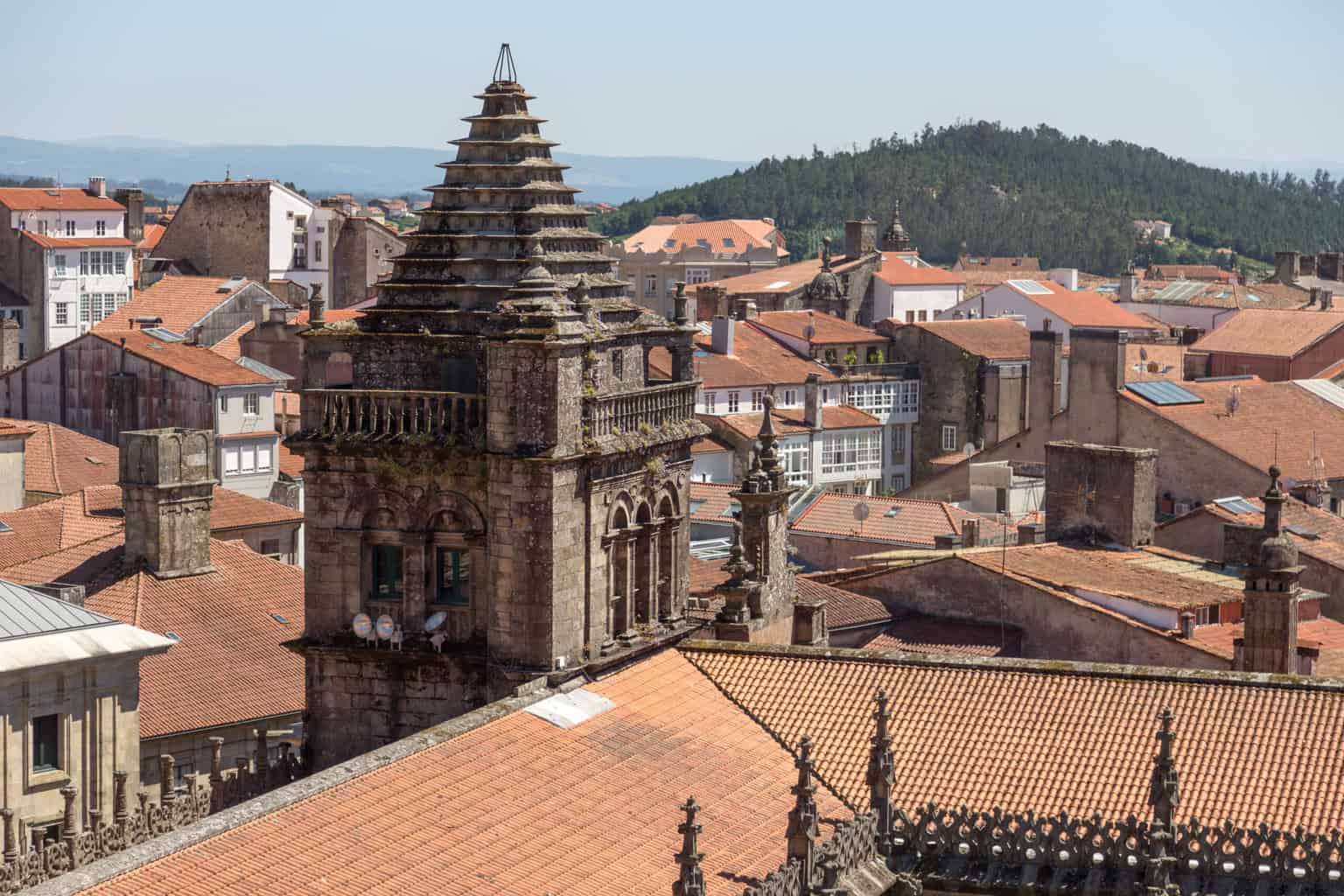
Few cities carry the weight of Santiago de Compostela and wear it so lightly. The moment you step into the Praza do Obradoiro and look up at the soaring façade of the Cathedral, you'll understand why pilgrims have been making this journey for over a thousand years. If your timing is right, the famous Pilgrim Mass is an experience that stays with you long after you've left.
Beyond the Cathedral, Santiago rewards slow exploration. The old town — a UNESCO World Heritage Site — is a maze of granite arcades, tapas bars and bakeries selling the city's famous almond cake, tarta de Santiago. The Mercado de Abastos is the perfect place to discover local cheeses, fresh seafood and a glass of Albariño. Lively, warm and full of unexpected energy, Santiago is far more than a finishing line — it's a destination in its own right.

Church in Padron

Padron

The last main town before reaching Santiago de Compostela on the Camino Portuguese is Padron and this is also the town where St James’ body was returned to the Iberian Peninsula from Jerusalem. A must-see in town is the Church of Santiago. There, below the altar, is the original stone O Pedrón, which is said to be the mooring post that the boat carrying St James was tied up to. Another wonderful place to visit is Monte Santiaguino – it is here that St James is said to have first preached in Spain. A short but steep walk up to Monte Santiaguino is well worth it for the tranquillity and views back over Padron.

Albarino Wine making grape picker

Albarino Wine

This section of the Camino Portuguese goes through the Albarino Wine region. There are a number of theories as to how wine came to be grown in the region – some suggest it was brought here by Germans, while others say it was French Monks. No matter how it got there, the wine is now widely available throughout the region and has a unique refreshing taste. Due to the proximity of the Atlantic Ocean this wine pairs very well with many local fish dishes, so why not eat and drink like the locals!! Salud!

Rooftop of the Cathedral de Santiago

Santiago de Compostela

Few cities carry the weight of Santiago de Compostela and wear it so lightly. The moment you step into the Praza do Obradoiro and look up at the soaring façade of the Cathedral, you'll understand why pilgrims have been making this journey for over a thousand years. If your timing is right, the famous Pilgrim Mass is an experience that stays with you long after you've left.
Beyond the Cathedral, Santiago rewards slow exploration. The old town — a UNESCO World Heritage Site — is a maze of granite arcades, tapas bars and bakeries selling the city's famous almond cake, tarta de Santiago. The Mercado de Abastos is the perfect place to discover local cheeses, fresh seafood and a glass of Albariño. Lively, warm and full of unexpected energy, Santiago is far more than a finishing line — it's a destination in its own right.

Start Planning Now !

CALDAS DE REIS

SANTIAGO DE COMPOSTELA

Starting from € 401
Number of People
Person Icon
Your Contact Details
Please fill the required fields

Services

Included in this package

Bed & Breakfast

Specially Hand-Picked Accommodation

Our Holiday or Pilgrim Pack

24/7 On-Call Support

Virtual Face-to-Face Pre-Departure Briefing

Add-On

Premium Accommodation

Airport Pick-Up

Additional Nights

Dinners

Luggage Transfers from Hotel to Hotel

Day Tours to Local Sites of Interest

Not included: Flights/trains, Insurance, Drinks/Lunch

Itinerary

Day

1

km miles

CALDAS DE REIS

Before setting off on your walk, take some time to discover Caldas de Reis, a charming spa town on the Camino Portugués with a history stretching back to Roman times. Stroll along the banks of the River Umia, where natural thermal springs still flow today, and wander through the town’s pleasant streets to visit the Iglesia de Santa María, a graceful church that has welcomed pilgrims for centuries.

Caldas de Reis is also the perfect place to sample filloas, a traditional Galician crêpe often enjoyed with local honey or cream — simple, delicious, and deeply rooted in the region’s culinary traditions. Settle in, enjoy the unhurried pace, and let the town ease you into the Camino spirit before the journey to Santiago begins.

Day

2

18.7 km11.6 miles

CALDAS DE REIS PADRON

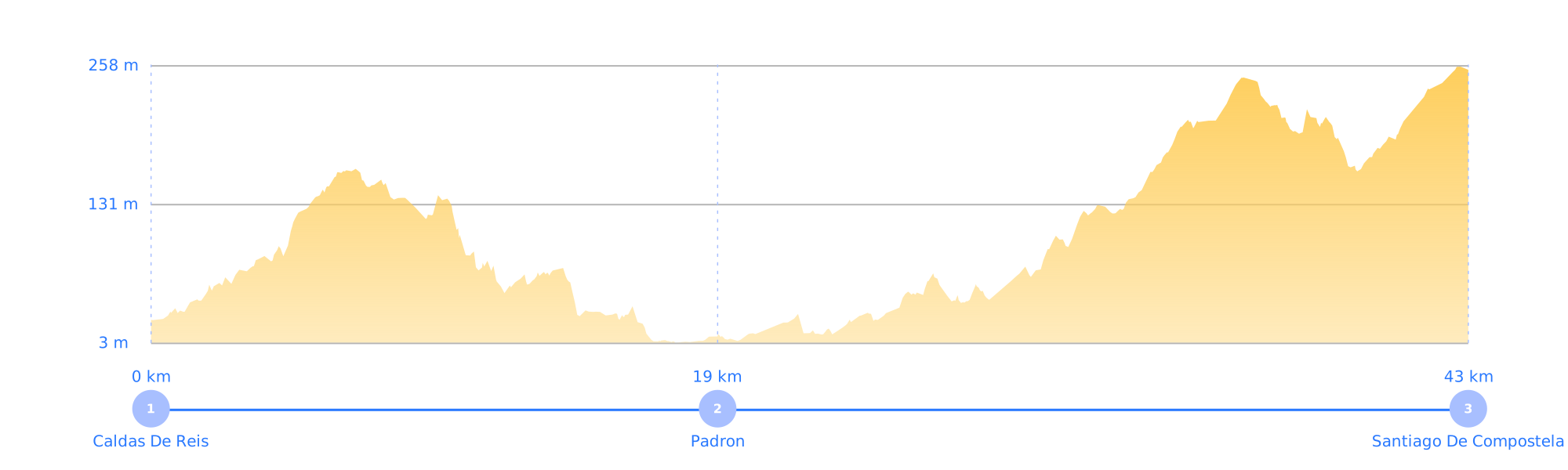
Exiting the town, we take a bridge over the River Umia that leads us to a fountain of hot spring water that has lent the town its name since Roman times. Entering the woods once more, the Camino makes its way gently uphill to the hamlet of Santa Marina. Going downhill, we cross the river Fontenlo. Finally, we catch up again with the river as we arrive in Padron. Padron is famous for being the first land sighted by the ship bearing the body of St James.

Day

3

24.7 km15.3 miles

PADRON SANTIAGO DE COMPOSTELA

The Camino passes through many small hamlets before arriving at the Baroque sanctuary of A Esclavitude. On a hilltop to the left stands the mysterious ruins of the hillfort Castro Lupario. A few kilometres later, we come to the oldest wayside crossing in Galicia. As we near Agro dos Monteiros, it’s now possible to see the spires of the cathedral in Santiago. Finally, the Camino passes by the ruins of a castle known as A Rocha Vella, before entering the city of the Apostle.

Day

4

km miles

SANTIAGO DE COMPOSTELA

After breakfast, we bid you farewell.
If you wish to stay in the area, we recommend that you:
– Take your time and visit the magnificent historic centre of Santiago.
– Continue with us along the wild Camino Fisterra (Finisterre Way), and stay overnight at the hotel in the lighthouse!
– Or take a bus to Fisterra to visit the unspoilt sandy coves and beaches of the west coast. With very few tourists, you are guaranteed a very special experience. Buses depart from Santiago Bus Station at 9am and 10am. Buses return to Santiago at 4:45pm and 7pm. The journey takes 3 hours.

Day

1

km miles

CALDAS DE REIS

Before setting off on your walk, take some time to discover Caldas de Reis, a charming spa town on the Camino Portugués with a history stretching back to Roman times. Stroll along the banks of the River Umia, where natural thermal springs still flow today, and wander through the town’s pleasant streets to visit the Iglesia de Santa María, a graceful church that has welcomed pilgrims for centuries.

Caldas de Reis is also the perfect place to sample filloas, a traditional Galician crêpe often enjoyed with local honey or cream — simple, delicious, and deeply rooted in the region’s culinary traditions. Settle in, enjoy the unhurried pace, and let the town ease you into the Camino spirit before the journey to Santiago begins.

Day

2

18.7 km11.6 miles

CALDAS DE REIS PADRON

Exiting the town, we take a bridge over the River Umia that leads us to a fountain of hot spring water that has lent the town its name since Roman times. Entering the woods once more, the Camino makes its way gently uphill to the hamlet of Santa Marina. Going downhill, we cross the river Fontenlo. Finally, we catch up again with the river as we arrive in Padron. Padron is famous for being the first land sighted by the ship bearing the body of St James.

Day

3

24.7 km15.3 miles

PADRON SANTIAGO DE COMPOSTELA

The Camino passes through many small hamlets before arriving at the Baroque sanctuary of A Esclavitude. On a hilltop to the left stands the mysterious ruins of the hillfort Castro Lupario. A few kilometres later, we come to the oldest wayside crossing in Galicia. As we near Agro dos Monteiros, it’s now possible to see the spires of the cathedral in Santiago. Finally, the Camino passes by the ruins of a castle known as A Rocha Vella, before entering the city of the Apostle.

Day

4

km miles

SANTIAGO DE COMPOSTELA

After breakfast, we bid you farewell.
If you wish to stay in the area, we recommend that you:
– Take your time and visit the magnificent historic centre of Santiago.
– Continue with us along the wild Camino Fisterra (Finisterre Way), and stay overnight at the hotel in the lighthouse!
– Or take a bus to Fisterra to visit the unspoilt sandy coves and beaches of the west coast. With very few tourists, you are guaranteed a very special experience. Buses depart from Santiago Bus Station at 9am and 10am. Buses return to Santiago at 4:45pm and 7pm. The journey takes 3 hours.

How to Get There

Getting to Caldas de Reis, Spain

To get to Caldas de Reis, it is best to fly to Santiago de Compostela.

Fly into Santiago de Compostela

Ryanair, Aer Lingus and Iberia/BA fly direct to Santiago de Compostela from the UK and Ireland. Ryanair flies from Stansted, Iberia/BA operates from Gatwick and Aer Lingus from Dublin. Santiago de Compostela can also be reached by a number of locations around Spain and Portugal, as well as major European cities. Iberia/BA offers the best selection of flights and you can fly to and from Santiago De Compostela returning to Frankfurt, Paris, Rome, Barcelona, Bilbao, Fuerteventura, Gran Canaria, Lanzarote, Madrid, Malaga, Palma, Seville, Tenerife and Valencia.

    Getting home from Santiago de Compostela, Spain

    Fly from Santiago de Compostela

    Shuttle buses from Santiago city centre to the airport depart every 20 minutes. Or, you can arrange an airport transfer with us that will collect you from your hotel.

      Getting to Caldas de Reis, Spain

      To get to Caldas de Reis, it is best to fly to Santiago de Compostela.

      Fly into Santiago de Compostela

      Ryanair, Aer Lingus and Iberia/BA fly direct to Santiago de Compostela from the UK and Ireland. Ryanair flies from Stansted, Iberia/BA operates from Gatwick and Aer Lingus from Dublin. Santiago de Compostela can also be reached by a number of locations around Spain and Portugal, as well as major European cities. Iberia/BA offers the best selection of flights and you can fly to and from Santiago De Compostela returning to Frankfurt, Paris, Rome, Barcelona, Bilbao, Fuerteventura, Gran Canaria, Lanzarote, Madrid, Malaga, Palma, Seville, Tenerife and Valencia.

        Getting home from Santiago de Compostela, Spain

        Fly from Santiago de Compostela

        Shuttle buses from Santiago city centre to the airport depart every 20 minutes. Or, you can arrange an airport transfer with us that will collect you from your hotel.

          Frequently Asked Questions

          How long is the Camino from Caldas de Reis to Santiago and how many days does it take?
          The Camino from Caldas de Reis to Santiago is approximately 43 km, following the final stretch of the Portuguese Way. Most pilgrims complete it in 2 walking days, making it an ideal short break that still delivers the full emotional and cultural experience of arriving in Santiago on foot.
          Is the Caldas de Reis to Santiago section suitable for beginners?
          Yes, this section is accessible to most walkers with a reasonable level of fitness. The paths are well-marked and the terrain is varied but not extreme, passing through woodland, farmland and traditional Galician villages. A little preparation goes a long way — break in your footwear before you go and build up to some longer walks in the weeks beforehand.
          Do I get the Compostela if I start in Caldas de Reis?
          No. Unfortunately, starting in Caldas de Reis does not cover the minimum 100 km required to receive the Compostela in Santiago de Compostela. To qualify for the official certificate, pilgrims must walk at least 100 km of a recognised Camino route.
          When is the best time to walk from Caldas de Reis to Santiago?
          The route can be walked year-round, but spring (April–June) and early autumn (September–October) are particularly lovely — mild temperatures, lush green landscapes and fewer crowds than the busy summer months. Galicia is known for its rain, so a good waterproof jacket is essential whatever time of year you visit.
          What should I pack for the Caldas de Reis to Santiago route?
          For a two-day walk, the golden rule is to pack light. Essentials include comfortable, well-worn walking shoes or boots, a compact waterproof, layers for changeable weather, a small daypack and your pilgrim passport (credencial). Trekking poles can be helpful on uneven paths, and a small first aid kit with blister plasters is always a good idea. Leave anything non-essential at home — your shoulders will thank you on day two. You can find a full guide on what to bring in our Camino Packing List.

          Start Planning your Adventure Now

          Walk the Camino to experience what is set to be the biggest Camino experience of the
          century so far. Embrace your freedom to explore and challenge yourself to walk the Camino.

          Search
          Blog
          Enquire Now
          Saved
          Log in
          Off season
          February Off season
          March Off season
          April Good time
          June Good time
          July Good time
          August Good time
          October Good time
          November Off season
          December Off season