
The next Holy Year on the Camino de Santiago falls in 2027 — and if you’ve been thinking about walking the Camino, this is the year to do it. Here’s what a Holy Year actually means, what makes 2027 so significant, and how to secure your place before availability runs out.
What Is a Camino Holy Year?
A Holy Year — known in Spanish as an Año Santo Compostelano or Año Xacobeo — occurs when the Feast of Saint James (25th July) falls on a Sunday. In these years, the Catholic Church grants a Plenary Indulgence to pilgrims who travel to Santiago de Compostela, attend Mass at the Cathedral, and fulfil certain religious conditions.
In practical terms, a Holy Year is one of the most significant events in the Catholic calendar — and one of the most dramatic surges in pilgrimage activity the Camino sees. But you don’t need to be Catholic, or even religious, to feel the difference. The sheer scale of collective energy, the celebrations, and the sense of walking in an ancient tradition running at full power — it draws pilgrims of every background.
Holy Years don’t follow a predictable schedule. They occur whenever July 25th lands on a Sunday, which means the gaps between them vary. After 2021, the next Holy Year is 2027. After that, 2032 — five years away.
If you’re weighing whether to make 2027 the year you finally walk the Camino, the answer is: yes, and here’s why.
Why 2027 Is a Particularly Big Deal
It follows an unusually long public buildup
The 2021 Holy Year was genuinely special — but it was also shaped by the pandemic. Restrictions, uncertainty, and reduced international travel meant that many pilgrims who had planned to walk in 2021 either couldn’t, or walked in reduced circumstances. Many of those pilgrims have been waiting ever since for another Holy Year to come around.
2027 will see that pent-up demand released in full. Pilgrim numbers are already trending upward year on year, and every indication from the Pilgrim Office in Santiago points to 2027 being one of the busiest — and most celebrated — Holy Years in living memory.
The Camino is experiencing a generational renaissance
Completions of the Camino have grown substantially over the past decade, with increasing numbers of walkers in their 20s, 30s, and 40s choosing the pilgrimage not for religious reasons but for the challenge, the community, the digital detox, and the perspective shift it offers. A Holy Year amplifies all of this — it’s a natural focal point for people who’ve been meaning to walk “someday.”
Santiago is preparing for something special
The city of Santiago de Compostela, the Galician regional government, and the national tourism bodies are investing heavily in the infrastructure and programming around 2027. Expect a full calendar of cultural events, exhibitions, and celebrations running throughout the year — not just around July 25th.
Choosing Your Route for the Holy Year
One of the most common questions we get at Follow the Camino is: which route should I walk? In a Holy Year, that question matters more than usual — because different routes offer very different experiences of the pilgrimage surge.
Here’s a practical breakdown:
Camino Francés — The Classic Route
Distance: ~780km from Saint-Jean-Pied-de-Port | Duration: 30–35 days for the full route; 7–14 days for popular sections
The Camino Francés is the most walked route in the world and the backbone of the pilgrimage network. It crosses the Pyrenees, cuts through Navarra, La Rioja, the Castilian meseta, and arrives in Santiago via the green hills of Galicia. The waymarking is excellent, infrastructure is well-developed, and the community of pilgrims on the trail at any given time is unlike anything else in travel.
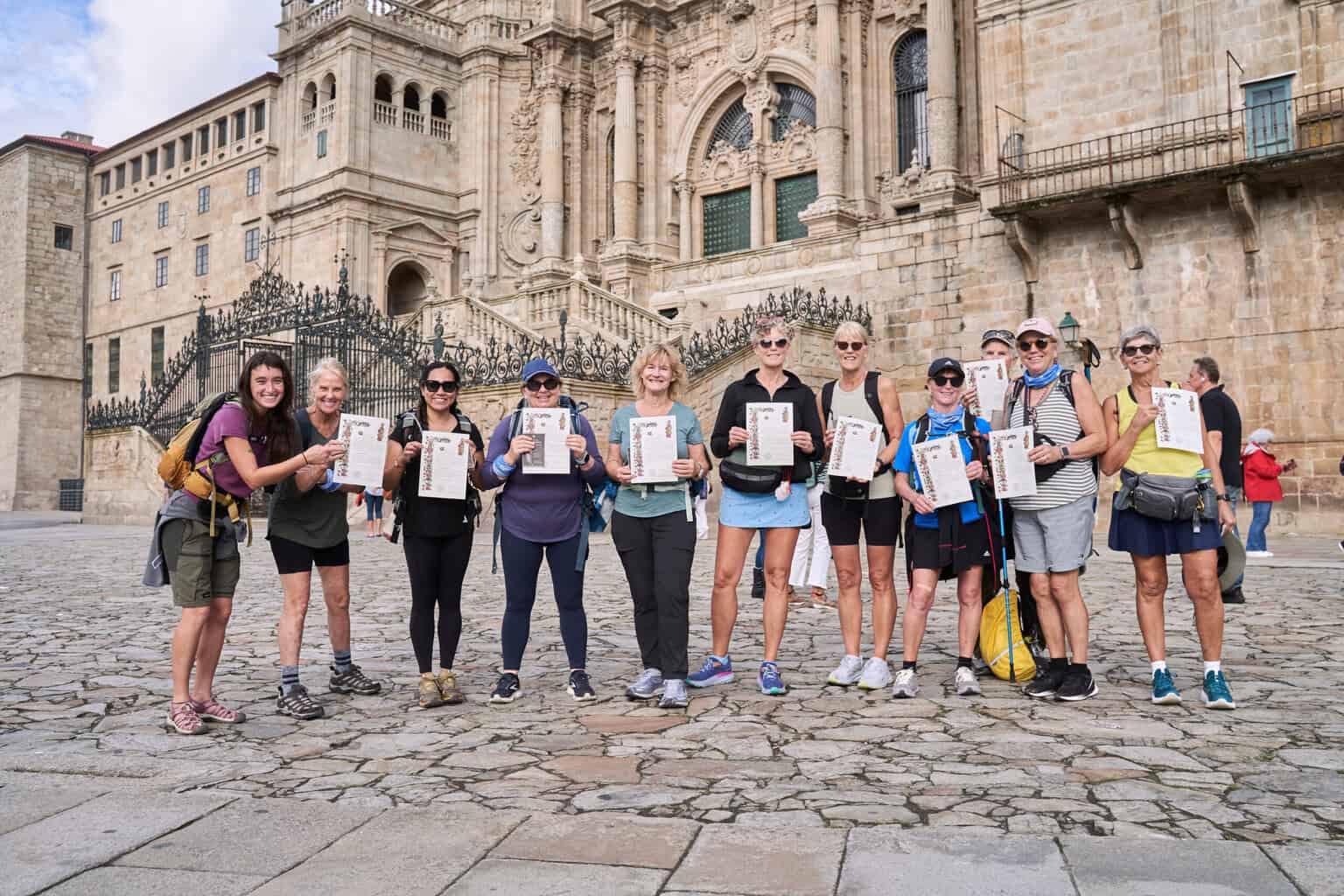
In a Holy Year, the Francés is electric. Towns along the route hold festivals, the albergues fill with walkers from dozens of countries, and arriving in Santiago’s Praza do Obradoiro during this period is an experience people talk about for the rest of their lives.
The practical consideration: It is also the most pressured route for accommodation in a Holy Year. Book early or travel with a guided operator who has reserved beds.
Who it suits: First-time pilgrims who want the full classic experience; those with 4+ weeks; people who thrive in a highly social environment.
Camino Português — The Smart Alternative
Distance: ~620km from Porto | Duration: 29 days from Porto; 25–28 days from Lisbon
The Camino Português has grown rapidly in popularity and is now the second most completed route. Starting from Porto (most popular) or Lisbon, it passes through northern Portugal before crossing into Galicia. The Coastal Variant — which follows the Atlantic coastline north from Porto — is one of the most scenic stretches of any Camino route.
The Português offers a slightly quieter, more intimate experience than the Francés, particularly outside peak summer months. It’s also more accessible for those with 2 weeks rather than a month.
The practical consideration: It qualifies fully for the Compostela certificate and Holy Year Plenary Indulgence, making it a complete Holy Year experience on a more manageable timescale.
Who it suits: Repeat pilgrims wanting a new route; first-timers with 2 weeks available; those who prefer coastal and river scenery; walkers who want a slightly less crowded experience without sacrificing the Holy Year atmosphere.
Camino del Norte — The Scenic Challenge
Distance: ~475km from San Sebastian | Duration: 20–25 days
Running along the northern coast of Spain through the Basque Country, Cantabria, and Asturias, the Norte is one of the most beautiful and least crowded routes. It’s also one of the most demanding, with significant daily elevation gain along its coastal cliffs and hilly terrain.
Who it suits: Experienced walkers seeking a challenge and a quieter experience; those with a full month and a desire to avoid crowds.
Camino Primitivo — The Original Pilgrimage
Distance: ~320km from Oviedo | Duration: 12–15 days
The oldest Camino route, the Primitivo is a mountainous, demanding walk through inland Galicia and Asturias. Pilgrim numbers are low, the scenery is spectacular, and the sense of walking an ancient, less-commercialised path is strong.
Who it suits: Physically fit walkers wanting solitude and authenticity; repeat pilgrims who have already walked the major routes.
Via de la Plata — The Long Road from the South
Distance: ~1,000km from Seville | Duration: 35–45 days
The longest Camino route, the Via de la Plata crosses the interior of Spain from Andalusia through Extremadura and Castile. It’s remote, demanding, and starkly beautiful — a serious undertaking for serious walkers.
Who it suits: Experienced long-distance walkers; those with 6+ weeks and a desire for genuine solitude.
Practical Planning: What You Need to Know for 2027
Book accommodation — now
This is not an exaggeration. The Camino Francés in particular has limited accommodation in key towns, and Holy Years put that accommodation under real pressure. Guided tours with pre-reserved beds, and private accommodation along popular routes, begin filling up 12–18 months in advance.
If you’re reading this in 2026, the time to act is now — not in spring 2027.
Choose your timing within the year carefully
The Holy Year runs January to December 2027, but different months offer very different experiences:
- Spring (April–June): Mild temperatures, manageable crowds, a building sense of anticipation. Excellent conditions on all routes.
- Summer (July–August): Peak season. The heat on the meseta can be serious (think 35–40°C). July 25th itself is an extraordinary day in Santiago. Book furthest in advance for this period.
- Autumn (September–October): Many experienced walkers’ preferred time. Cooler, beautiful light, grape harvest season in La Rioja. Crowds are lower than summer but the Holy Year energy is still strong.
- Winter (November–February): Very quiet. A genuine wilderness experience, particularly on the Francés. Weather in Galicia can be wet and cold. Not recommended for first-timers.
Train before you go
The Camino is not technically difficult, but the cumulative load of multi-week daily walking puts real demands on feet, knees, and hips. Begin a dedicated walking programme 3–4 months before your departure. Walk in your actual boots. This single step prevents the majority of Camino injuries and is the most common advice we give to prospective pilgrims.
Decide how you want your logistics handled
There are three main approaches:
- Fully independent — you book your own accommodation, carry your own bag, and navigate yourself. Rewarding, but requires significant advance planning in a Holy Year.
- Self-guided with support services — you walk independently but use a luggage transfer service (your bag is transported to your next stop each day) and have pre-booked accommodation waiting for you. A good middle ground.
- Guided tour — your accommodation, route, luggage logistics, and local expert guidance are all managed for you. This allows you to focus entirely on the walk itself, which is particularly valuable for first-time pilgrims or those who want to make the most of a once-in-several-years opportunity.

Walking the Holy Year with Follow the Camino
We’ve been guiding pilgrims on the Camino de Santiago for years. Our team has walked every major route, knows the accommodation network intimately, and understands what makes the difference between a good Camino and a great one.
For 2027, we have already launched our guided Holy Year tours across multiple routes, including the Camino Francés and Camino Português. These tours are designed specifically to take the logistical pressure off Holy Year walking — so that the energy you’d otherwise spend on planning goes entirely into the experience.
What’s included in our guided tours:
- Handpicked, pre-booked accommodation throughout
- Expert local guides who know the routes in depth
- Full daily baggage transfer
- Group sizes designed for a genuine Camino experience — not a package holiday
- Flexibility to adjust pace and stops where needed
- Pre-departure briefing and full route documentation
Our 2027 tours are already receiving strong interest. If you want to walk the Holy Year with us, we’d strongly encourage enquiring sooner rather than later.

2027 is a rare opportunity. Holy Years come around infrequently, and this one is shaping up to be one of the most significant in decades. Whether you’re drawn to the scale and energy of the Camino Francés, the coastal beauty of the Português, or the challenge of a less-walked route, the Holy Year is the right context for your Camino.
The single biggest mistake prospective pilgrims make is waiting too long to book.
Follow the Camino is a specialist Camino de Santiago tour operator. Our 2027 Holy Year guided tours are now open for enquiries and bookings.