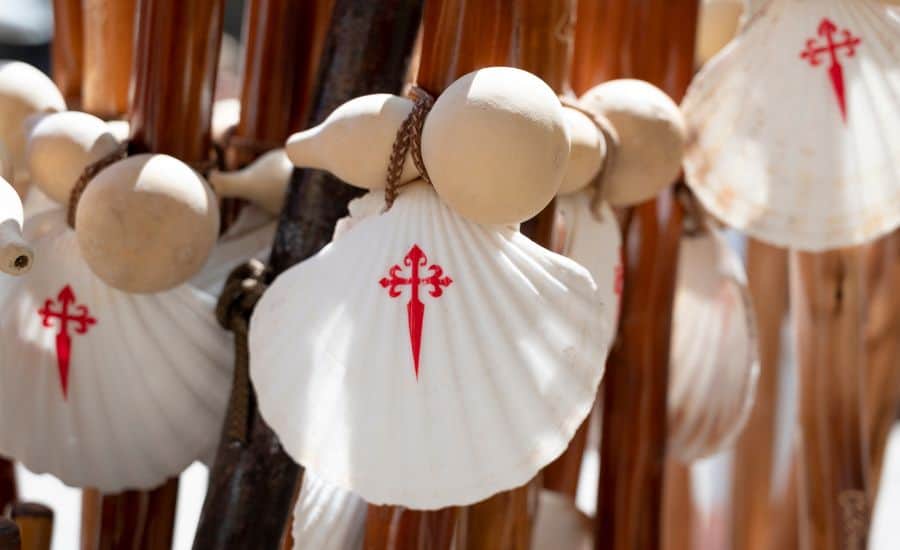
Walk any stretch of the Camino de Santiago and you will start seeing it everywhere. Stencilled in powdered sugar on a slice of almond cake. Hanging from a leather cord in a souvenir shop in Sarria. Painted on a waymarker next to a yellow arrow. Stamped in your pilgrim passport. It is a red cross that looks a little like a sword, and once you notice it, you can’t stop noticing it.
This is the Cross of Saint James, also called the Cross of Santiago, the St James cross or, in Spanish, the Cruz de Santiago. Along with the scallop shell, it is the symbol most closely tied to the Camino. But unlike the shell, which almost every pilgrim can explain, the cross raises questions. Why is it shaped like a sword? Why is it red? And what does a medieval order of knights have to do with a walk to Santiago de Compostela?
In this guide, our team shares what we know about the origin and meaning of the Cross of Saint James, the legends behind it, and where you can find it as you walk.
What is the Cross of Saint James?
The Cross of Saint James is a red Latin cross whose lower arm ends in a sharp point, like the blade of a sword. The other three arms finish in a flower shape, the fleur-de-lis, which makes the top of the cross look like the hilt and guard of a sword. In heraldry, this design is known as a cross fleury fitchy.
That is why many people simply call it the sword cross. It is not a weapon and not quite a traditional crucifix either. It sits somewhere in between, and that tension is exactly where its meaning comes from.

Who was Saint James?
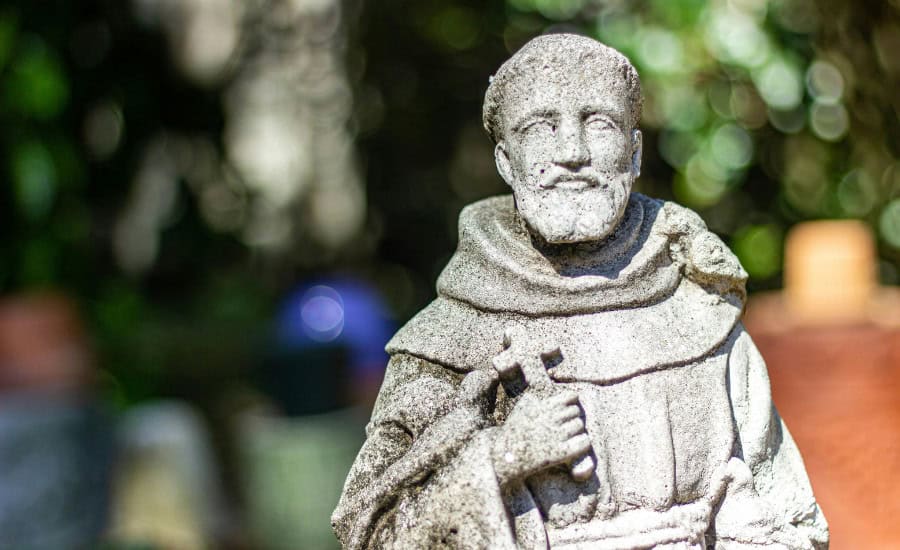
To understand the cross, it helps to start with the man it is named after. Saint James the Greater, Santiago in Spanish, was one of the twelve apostles and one of Jesus’ closest companions. According to tradition, he preached in the Iberian Peninsula before returning to Jerusalem, where he was beheaded by sword around 44 AD, becoming the first apostle to die for his faith.
Legend says his disciples carried his body by boat to the coast of Galicia. Centuries later, in the early 9th century, his tomb was said to be found in a field beneath a shower of stars, and the city of Santiago de Compostela grew around it. That discovery is what set the first pilgrims walking. If you’d like the full story, we tell it in our article Who Was St. James the Apostle?

The origin of the Cross of Santiago
There is no single, documented moment when the cross was “invented.” Instead, its story is woven from history and legend, and both are worth knowing.
The Order of Santiago (the historical origin). The cross as we know it today became famous as the emblem of the Order of Santiago, a religious and military order founded around 1170 in Cáceres, in the Kingdom of León, under King Ferdinand II. Its first Grand Master was Pedro Fernández. Pope Alexander III confirmed the order in a papal bull dated 5 July 1175. The Knights of Santiago wore the red sword cross on their white mantles, and their mission combined two roles: defending the frontier during the Reconquista and protecting pilgrims on their way to the tomb of Saint James.
Over the centuries the order grew into one of the most powerful institutions in Spain, with its main seat at the monastery of Uclés. At the end of the 15th century, the Catholic Monarchs brought it under the Crown. It still exists today as an honorary order, with the King of Spain as its sovereign.
The Battle of Clavijo (the legend). Spanish tradition links the cross to the legendary Battle of Clavijo, said to have taken place in 844. According to the story, Saint James appeared on a white horse, carrying a white banner with a red cross, and led the Christian army to victory. This is the origin of the image of Santiago Matamoros, Saint James as a mounted warrior, which you will see in churches along the Camino. Most historians today consider the battle a legend rather than a documented event, but it shaped how Spain saw its patron saint for centuries.
The crusaders’ portable cross (a popular theory). Another explanation you will often hear is more practical. Medieval knights and crusaders are said to have carried small crosses with a sharpened lower end, so they could push them into the ground and pray wherever they camped. Whether or not this is how the shape began, it captures something true about the Camino: faith that travels with you.

What does the Cross of Saint James mean?
Every part of the Cross of Santiago carries a meaning. Here is how it is traditionally read.
| Element | What it represents |
|---|---|
| The red colour | The blood of Saint James, martyred by the sword, and the courage of those who defended the faith |
| The sword-shaped lower arm | The way Saint James died, and the knightly spirit of the Order of Santiago |
| The three fleurs-de-lis | “Honour without stain”, a reference to the apostle’s moral character |
| The cross itself | The Christian faith that sent millions of pilgrims to Santiago over more than a thousand years |
What we find most beautiful is how the meaning has softened over time. A symbol that began in a world of knights and battles is now worn by walkers from every country and every belief. For many pilgrims today, the Cross of Saint James stands for perseverance, protection on the road and the quiet strength it takes to keep going, one stage at a time.

The Cross of Saint James in art and culture
The Santiago cross has left its mark well beyond the Camino.
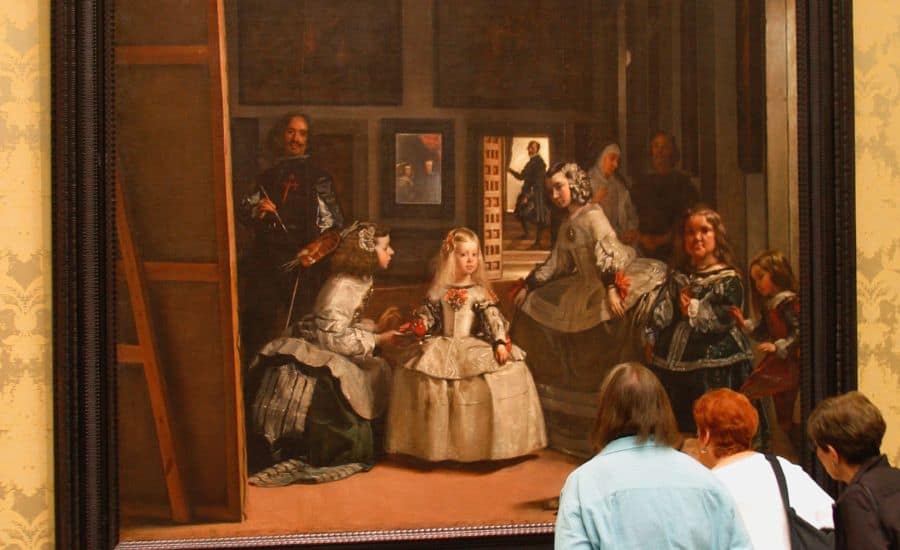
- Velázquez’s Las Meninas (1656). Look closely at the painter’s self-portrait in this famous work at the Museo del Prado and you will see the red cross on his chest. It was added after Velázquez was made a Knight of Santiago in 1659, a few years after he finished the painting.
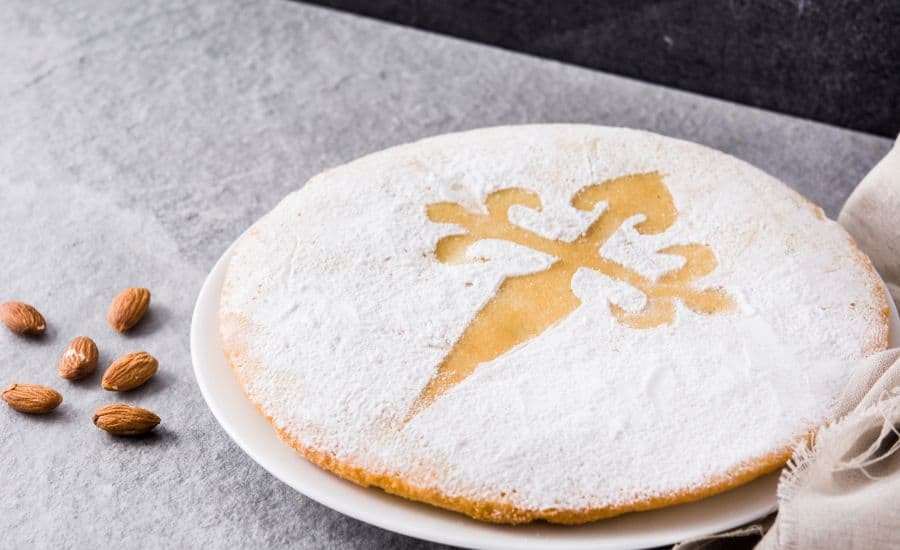
- Tarta de Santiago. Galicia’s famous almond cake is dusted with icing sugar over a cross-shaped stencil, leaving the Cross of Saint James on top. It is the sweetest way to meet the symbol, and a well-earned treat at the end of a walking day.
- Coats of arms and orders. You will find the cross in the heraldry of Spanish towns and noble families, and Portugal has its own Order of Saint James of the Sword.
- Jewellery and tattoos. St James cross necklaces, pins and rings are among the most popular Camino keepsakes, and many pilgrims choose a small tattoo of the cross to remember their journey.
Where to see the Cross of Saint James on the Camino
Once you start walking, the cross becomes a quiet companion. Here are some places where you are likely to meet it.
- León, on the Camino Francés. The Hostal de San Marcos, today a Parador, was once a pilgrim hospital and a key house of the Order of Santiago. Its long Renaissance façade is a reminder of how closely the knights and the pilgrimage were linked. You will pass it on our Camino Francés trips.
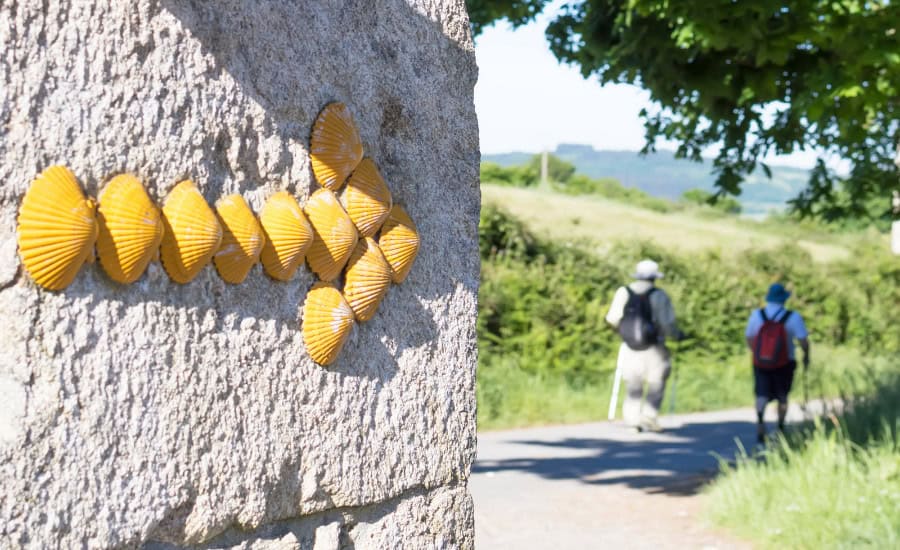
- Waymarkers and village churches. The cross often appears next to the scallop shell on markers, fountains and church doors, especially in Galicia.
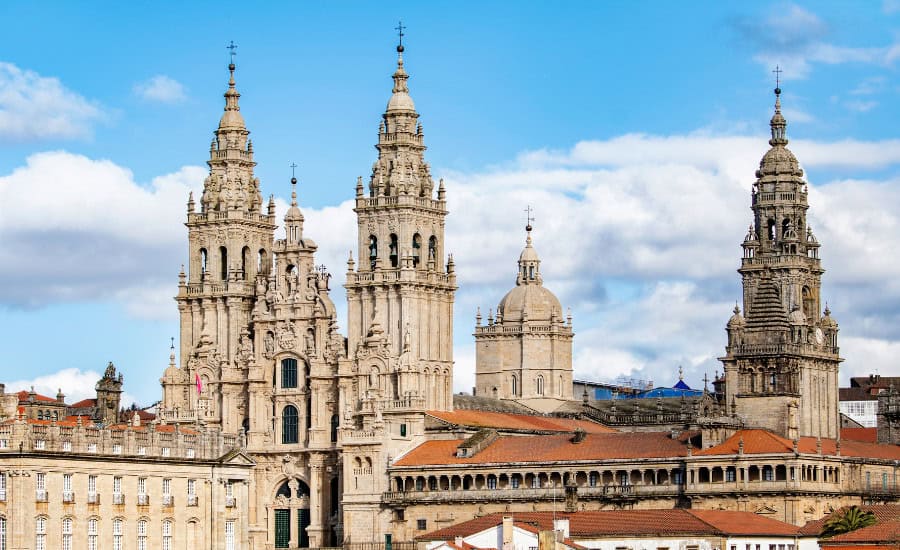
- Santiago de Compostela. In the old town, the cross is everywhere: on shop signs, bakery windows, pilgrim souvenirs and of course on the Tarta de Santiago.
- Your pilgrim passport. Many of the stamps (sellos) you collect along the way feature the cross, alongside the shell. Looking back at them at the end is one of the loveliest moments of the journey.
If you’re curious about the other emblems you’ll see along the way, from the yellow arrow to the pilgrim’s gourd, take a look at our guide to the scallop shell and other symbols of the Camino.

Cross of Saint James vs scallop shell: what’s the difference?
Pilgrims often ask us which one is “the” symbol of the Camino. The honest answer is both, but they tell different stories.
The scallop shell is the badge of the pilgrim. It speaks of the journey itself, the many roads that come together in Santiago like the lines of a shell, and in the Middle Ages it was proof that you had reached Galicia. The Cross of Saint James speaks of the apostle and of the people who protected the road: his martyrdom, the knights of the Order of Santiago and the faith at the heart of the pilgrimage. Many pilgrims carry both, and you will often see them side by side.
Walk the Way of Saint James with us
Knowing the story behind the Cross of Santiago changes the way you walk. That red cross on a stone marker stops being decoration and becomes a reminder that you are following a path walked for more than a thousand years, by people who also needed a little faith, and a little help, to reach the end.
That’s where we come in. For 20 years, our team has been looking after pilgrims on the Camino: we arrange your accommodation, move your luggage each day and stay on call if you need us, so you can focus on what the journey means to you. If 2027 is calling you, it is a special time to go, because it is a Holy Year, when the Holy Door of Santiago Cathedral opens and the city celebrates its apostle in a very particular way.
Ready to start? Talk to our Camino experts and we’ll help you choose the route that feels right for you.