Two kinds of pilgrim reach Assisi. One hands a small folded card across the desk at the pilgrim office, soft at the edges and covered in inked stamps, and walks out with a certificate. The other finds out at that same desk that the card existed, and that stamps cannot be added after the fact.
The credential is not a formality. It is the document that turns a long walk in Umbria into a recognised pilgrimage, and it is the only proof accepted when you ask for your certificate at the end. It costs very little and takes a few minutes to organise before you leave home, which is the whole point: it is one of the few things on this route you cannot fix once you have started.
Here is everything you need to know about the credential, the Testimonium, and the symbols you will be following through Tuscany, Umbria and Lazio.

What the pilgrim credential is
The credential, or Credenziale del Pellegrino, is an official travel document issued by a religious authority. It identifies you as a pilgrim rather than a walker or a tourist, and it works in a very simple way: as you progress, you collect dated stamps, called timbri, at each stage.
Churches, parish offices, tourist information points and pilgrim offices along the way all give stamps. There is no strict rule about how many you need per day, but the dates matter, because they are what demonstrate that you covered the distance on foot rather than by bus.
Treat it as a working document rather than a souvenir, at least until you reach Assisi. Keep it dry, keep it accessible, and ask for a stamp before you sit down rather than after, when the office may have closed for the long Italian lunch.
If you walk with us, your credential is included and arrives before you travel, so there is nothing to arrange yourself. If you are organising your own walk, request one from the official Via di Francesco organisation at least three weeks ahead, and allow two months if you live outside Italy.
The Testimonium, and what you need to earn it
The Testimonium is the certificate of completed pilgrimage. Its full title is Testimonium Peregrinationis Peractae ad Sanctorum Francisci et Clarae Civitatem, which is a very grand way of saying you walked to the city of Francis and Clare and can prove it.
The distance you need to cover
To qualify, you need to have completed at least 100 km on foot, or 200 km by bicycle, arriving at the tomb of the saint in Assisi. The stamps and dates in your credential are the evidence. There is no other paperwork and no online application.
This is the same threshold used on the Camino de Santiago and the Via Francigena, which surprises some pilgrims who assume the Italian routes work differently. They don’t.
Where to collect it in Assisi
The Testimonium is issued in person, in Assisi, and nowhere else. You present your stamped credential at the Statio Peregrinorum, the pilgrim office at the Sacro Convento, on the lower square of the Basilica of St Francis.
Statio Peregrinorum Piazza Inferiore di San Francesco, 2, Assisi (PG) Tel. +39 075 819 001 Typically open 10:00–12:30 and 15:00–17:30 ⚠️
A friar or volunteer will look through your credential, register your arrival, add the final stamp and hand over the certificate. There is no charge, though a small donation is customary. Ask for a cardboard tube while you are there, because a rolled certificate survives a suitcase and a flat one does not.
Hours do shift with the season and with the volume of pilgrims, so check on the day rather than planning your afternoon around them.
One detail worth building into your last day: from April to October a Pilgrim’s Mass is celebrated at 18:00 on weekdays in the lower church, at the Chapel of Santa Caterina, and at 17:00 on Sundays at the main altar. It is intended specifically for people who arrived on foot. Many pilgrims describe it as the moment the walk actually ends.
If your route finishes in Rome
Some pilgrims walk south from Assisi and finish at St Peter’s rather than turning back. If that is your plan, there is a separate completion certificate for those who have covered at least 100 km into Rome. You receive your final stamp at St Peter’s Basilica and collect the certificate from the Vatican pilgrim office. ⚠️
If you walk less than 100 km
You still get something, and this is the part almost nobody mentions. Pilgrims who arrive in Assisi having walked a shorter distance can ask for the Chartula Peregrini, a diploma that recognises the spirit of the pilgrimage regardless of kilometres covered. It carries the blessing Francis wrote for Brother Leo.
So if you have a week rather than a fortnight, or if your knees have opinions about long descents, you are not walking for nothing. Say so at the pilgrim office and ask.

The yellow Tau, and why you are following a letter
The symbol painted on rocks and bolted to posts along the route is a Tau: a capital T, usually in yellow.
It is the last letter of the Hebrew alphabet, and in the book of Ezekiel it appears as a mark placed on the foreheads of the faithful to set them apart and protect them. Francis adopted it as his personal emblem. He signed letters with it and painted it on the walls of places where he stayed. For him it stood for the cross, and for the Franciscan values of humility, simplicity, peace and respect for every living thing.
Which means the thing keeping you on the correct path is also the thing Francis used to sign his name. Pilgrims tend to notice this somewhere around day four, usually while catching their breath on a hill.
Yellow was chosen for visibility rather than symbolism, and it works. Once your eye is trained, you spot them from a distance.
How to read the waymarks
Signage on the Via di Francesco is complete, well maintained and marked in both directions, so the route can be walked north to south or south to north.
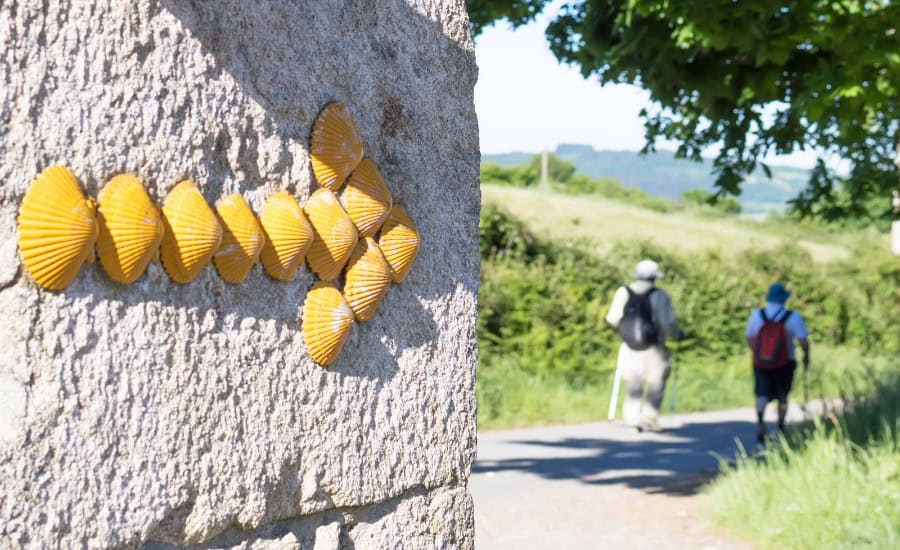
Vertical signs are metal, banded in blue and yellow, and carry the yellow Tau alongside a directional arrow. Horizontal markers are painted directly onto rock, walls and trees. The two systems work together, and they cluster at junctions and changes of direction, which is where you need them.
The regional variations are worth knowing before you set off:
- Tuscany: the red-and-white CAI trail markings, combined with the yellow Tau
- Umbria and Lazio: yellow-and-blue trail signs plus the yellow Tau, including small colour-matched stakes at ground level
Markers sit roughly every 200 metres. Because the path runs through woodland and farmland, vegetation occasionally hides one, so if you haven’t seen a marker in a few minutes, keep going a little further before doubling back.
The one rule that matters: several waymarked routes overlap in this part of Italy, including the green markers of the Cammino di Assisi and the Tau of the “Di qui passò Francesco” association. Pick one system at the start and follow it consistently. Switching between them mid-day is how people end up somewhere scenic and unplanned.
You will also have our route notes and GPS tracks in the app, so a hidden Tau is an inconvenience rather than a problem.

Two tombs in Assisi
St Francis
Francis died on the evening of 3 October 1226 and is buried in the crypt beneath the Lower Basilica of San Francesco. The basilica was built on two levels: the lower church, which holds the tomb, and the upper church, with its cycle of frescoes by Giotto.
The crypt as you see it today is largely a product of restoration work in the 19th and early 20th centuries, which blended neoclassical and neo-Romanesque elements. Popes John XXIII, John Paul II, Benedict XVI and Francis have all prayed here as pilgrims.
Go early or go late. In the middle of the day the queue moves briskly but the silence is harder to find.
St Carlo Acutis
A short walk uphill is a second tomb that has changed the shape of pilgrimage to Assisi.
Carlo Acutis was born in London in 1991, raised in Milan, and died of leukaemia in 2006 at the age of fifteen. He built a website cataloguing Eucharistic miracles around the world, which is why he is often called the patron saint of the internet. He asked to be buried in Assisi because of his devotion to Francis.
He was beatified in 2020 and canonised on 7 September 2025 by Pope Leo XIV, in St Peter’s Square, alongside Pier Giorgio Frassati. He is the first millennial saint. His tomb is in the Shrine of the Renunciation, inside the church of Santa Maria Maggiore, and his feast day is 12 October.
For younger pilgrims in particular, the two tombs sit together in an interesting way: a man who gave away everything he owned in the thirteenth century, and a teenager who used a laptop, eight centuries apart and a few hundred metres of cobbles between them.
2026 and the Jubilee Year of Saint Francis
If you are walking this route now, you have arrived in an unusual year.
2026 marks 800 years since the death of Francis. Pope Leo XIV has proclaimed a Jubilee Year of Saint Francis, running from 10 January 2026 to 10 January 2027, opened at the Basilica of Santa Maria degli Angeli in front of the Porziuncola. The Apostolic Penitentiary has issued a decree granting a plenary indulgence under the usual conditions, which include participating in Jubilee celebrations, prayer in the Franciscan spirit, and daily acts of charity and humility.
The anniversary is the last stage of a cycle of Franciscan centenaries that began in 2023: the approval of the Rule and the Christmas crib at Greccio, then the Stigmata at La Verna in 2024, then the Canticle of the Creatures in 2025.
Two dates to know:
- 3 October 2026 is the 800th anniversary of the Transitus, the Franciscan term for Francis’s passing. He died at the Porziuncola, having asked to be laid naked on the bare earth. Every year on that evening the friars mark it in the Chapel of the Transitus, behind the Porziuncola in Santa Maria degli Angeli. This year the rite carries eight centuries behind it.
- 4 October 2026 is the feast of St Francis, and for the first time since 1977 it is a national public holiday in Italy. Francis has been a patron saint of Italy since 1939, and parliament voted almost unanimously in 2025 to restore the holiday in time for the centenary.
Practical consequence: the first week of October in Assisi will be busier than usual, and a public holiday affects transport, shop hours and restaurant availability across the whole country. If you are walking in late September or October, plan around it rather than into it. We build itineraries with that in mind, and if you would rather see Assisi quietly, the shoulder weeks either side are a very different experience.
One thing to eat before you leave
Pane di San Francesco is a sweet bread from Assisi with medieval roots, made in honour of the saint and served during the major religious festivals. It is enriched with honey, raisins and candied fruit, and it is dense rather than light, with lemon zest and wildflower honey through the dough and a long slow fermentation behind it.
It suits the place. Simple ingredients, no hurry, more care than the recipe strictly requires.

Walking the Via di Francesco with us
We have been organising pilgrimages since 2006, and we stay in constant conversation with pilgrim offices, local hosts and other route specialists in Italy. That is how we know when a stage has been rerouted, when a basilica has changed its hours, and what the first week of October is realistically going to look like this year.
When you walk the St Francis Way with us, your credential is arranged before you travel, your route notes and GPS tracks are in the app, your bags move ahead of you each morning, and there is someone on the end of a phone at any hour if something goes sideways. You carry a day pack and your attention, and nothing else.
If you are weighing up which section to walk, or you want your itinerary to finish in Assisi so that the Testimonium is waiting for you, talk to us. We will help you choose the stage that fits the time you have, the pace you want and the certificate you are hoping to bring home.